
Most Hydraulic Leaks Trace Back to a Specification Mismatch
When a hydraulic connection leaks, the cause is not always poor assembly. In many cases, the fitting style, material, size, or thread standard was never matched correctly to the circuit in the first place. For industrial buyers, maintenance teams, and OEM engineers, stainless steel JIC fittings are frequently specified when a system needs a reusable metal-to-metal seal, dependable vibration resistance, and far stronger corrosion performance than plated carbon steel in aggressive service environments.
The decision goes well beyond confirming that a fitting is simply “JIC.” Buyers must verify the dash size, tube outside diameter, thread pitch, seat angle, stainless grade, port interface, and hose compatibility together. A JIC male end can look almost identical to other flared fittings, yet a small mismatch in seat angle or thread pitch can produce sealing failure, damaged seats, galled threads, or unsafe operating pressure in the field.
This guide explains how JIC fittings create their seal, where stainless steel JIC fittings add measurable value, how common dash sizes are identified in procurement, and exactly what to check before sourcing parts for hydraulic power units, chemical processing equipment, marine and offshore systems, food and beverage lines, and other demanding applications.
How the 37-Degree JIC Flare Actually Seals
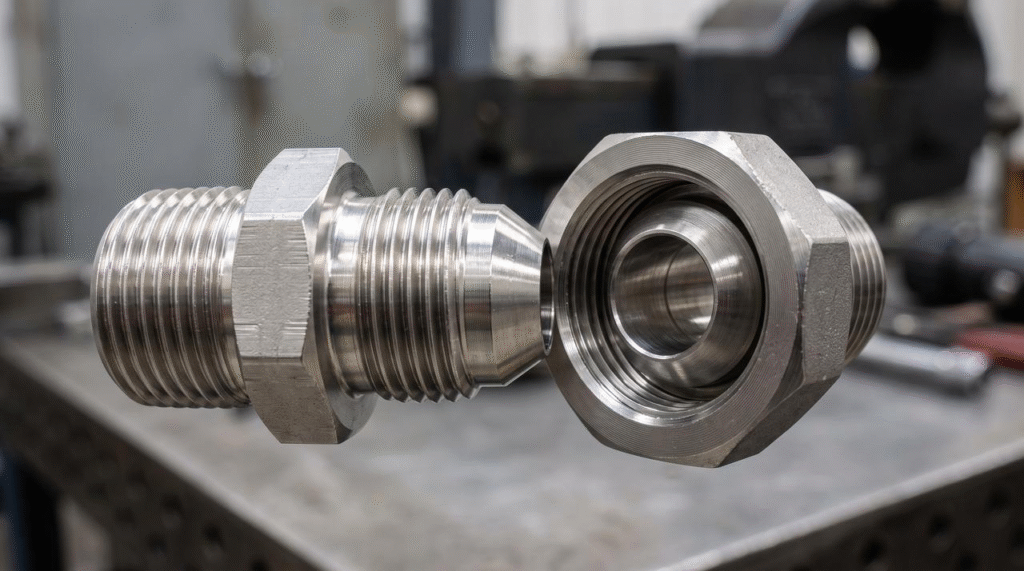
JIC fittings rely on a 37-degree flared sealing surface, an interface commonly associated with SAE J514. The thread pulls the male and female halves together, but the thread itself is not the primary seal. Sealing occurs when the 37-degree cone seat makes firm contact with the matching flare or seat on the mating component. This metal-to-metal action is why JIC fittings dominate hydraulic circuits where a mechanical seal is preferred over an elastomer.
The design offers several practical advantages. Connections can be assembled and disconnected repeatedly for maintenance, they are available in a broad range of shapes and sizes, and they route reliably where hose ends, adapters, valves, and rigid tubes must join. Unlike tapered pipe threads such as NPT, JIC connections do not depend on thread deformation to seal, so a correctly installed joint is far easier to service and reuse.
That same design also demands precision. The 37-degree seat must be clean, undamaged, and matched to another true 37-degree JIC interface. A 45-degree SAE flare, a metric cone, or a similar-looking fitting may thread together partially but will never seal correctly. For engineering teams standardizing assemblies, documented thread identification and seat inspection procedures are essential to avoid mixed-standard failures.
Why Engineers Choose Stainless Steel Over Plated Carbon Steel
Carbon steel hydraulic fittings suit many general industrial systems, especially where cost efficiency and high mechanical strength are the leading priorities. Stainless steel becomes the better choice when corrosion resistance, surface cleanliness, fluid compatibility, or environmental exposure drives the decision. In washdown zones, offshore platforms, marine equipment, chemical processing, and persistently humid environments, stainless steel reduces external corrosion and extends service life between rebuilds.
Stainless steel JIC fittings are also selected where contamination control matters. Rust, plating breakdown, or surface corrosion can shed particles and create maintenance issues in sensitive systems. Industries such as biopharmaceuticals, food and beverage, energy, and process equipment manufacturing routinely evaluate stainless components because they need cleaner surfaces and more stable long-term performance under repeated cleaning and demanding duty cycles.
The correct stainless grade depends on the environment and the media. Austenitic stainless steels such as 304 and 316 are the grades most often discussed in hydraulic and process piping applications, with 316 generally favored where chloride exposure, salt spray, or stronger corrosion resistance is required. Final material selection should account for fluid chemistry, temperature, pressure, cleaning agents, and surrounding atmosphere rather than relying on the material name alone. For a deeper comparison, review guidance on stainless steel hydraulic fittings.
What JIC Dash Size Numbers Really Mean in Procurement
JIC fittings are commonly described by dash sizes such as -04, -06, -08, or -12. These dash numbers relate to tube outside diameter in sixteenths of an inch: -04 corresponds to 4/16 inch, or 1/4 inch tube OD. The dash size is useful for quick shop-floor communication, but buyers should still confirm the actual thread diameter and pitch before releasing an order, because dash size alone does not fully define the connection.
A complete specification should state the fitting type, material, end connection, dash size, shape, and any applicable standard. A purchasing description might identify a stainless steel JIC male to NPT male adapter, or a stainless JIC female swivel hose fitting for a specific hose size. When the fitting terminates a hose assembly, the hose inside diameter, ferrule, and crimp compatibility become just as important as the JIC end itself.
Thread confusion is one of the most common causes of incorrect ordering. JIC, ORFS, NPT, BSP, and metric fittings often coexist on the same hydraulic power unit or machine platform. For teams managing mixed equipment fleets, a structured hydraulic thread identification process reduces downtime, returns, and field assembly errors, and it protects the 37-degree seat from being cross-threaded against the wrong standard.
Common JIC Dash Sizes and Thread References
| Dash size | Tube OD reference | Common JIC thread |
|---|---|---|
| -04 | 1/4 in | 7/16-20 UNF |
| -06 | 3/8 in | 9/16-18 UNF |
| -08 | 1/2 in | 3/4-16 UNF |
| -10 | 5/8 in | 7/8-14 UNF |
| -12 | 3/4 in | 1 1/16-12 UN |
| -16 | 1 in | 1 5/16-12 UN |
| -20 | 1 1/4 in | 1 5/8-12 UN |
| -24 | 1 1/2 in | 1 7/8-12 UN |
Where Stainless JIC Fittings Perform Best in Hydraulic Circuits
Stainless JIC fittings are used in pressure lines, return lines, pilot circuits, test points, lubrication systems, and auxiliary equipment where a flared connection suits the operating conditions. They appear frequently in mobile machinery, hydraulic power units, industrial presses, offshore equipment, shipboard hydraulics, and process skids that combine hydraulic power with corrosive or high-frequency washdown environments.
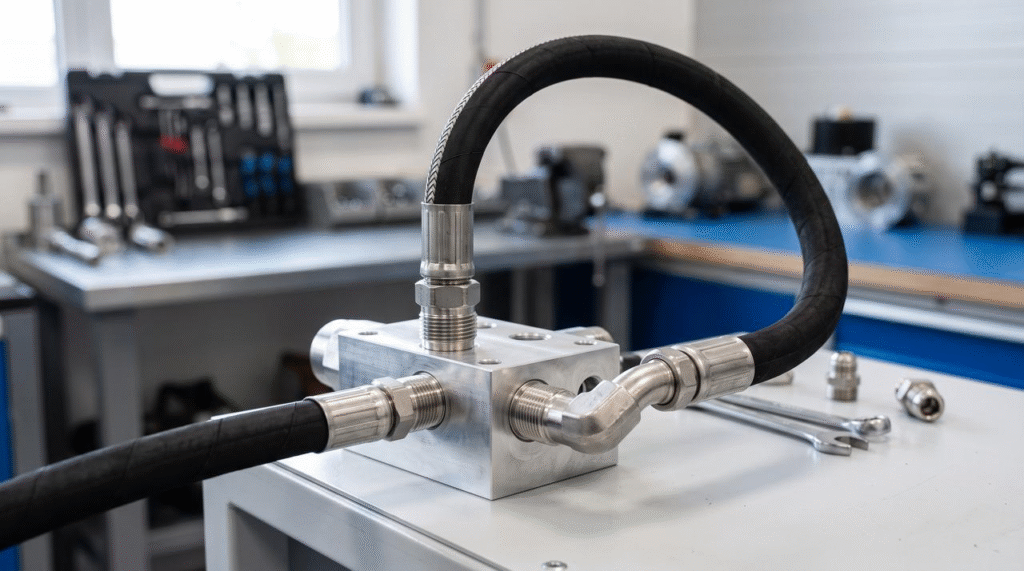
In hose assemblies, JIC ends are often preferred because maintenance teams recognize them instantly and they fit many equipment layouts. A JIC female swivel hose end simplifies installation because the hose can be oriented without twisting the entire assembly. For hose production and replacement programs, compatible SWAGED HOSE FITTING options should be matched to the hose construction, crimp specification, and required end connection so the finished assembly holds pressure and resists fatigue.
JIC adapters also transition between ports and connection standards. A single circuit may require JIC on one side and NPT, BSP, ORFS, or metric on the other. In these cases, selecting the right ADAPTER is far more than a thread conversion; it influences sealing method, installation space, wrench clearance, and long-term maintenance access at the port.
Choosing Straight, Elbow, Tee, and Swivel Configurations
Fitting geometry can matter as much as the thread. Straight JIC fittings are the most efficient choice when the hose or tube can run directly to the port without stress. Elbow fittings, typically 45-degree or 90-degree, route hoses around frames, guards, cylinders, and manifolds. Tee fittings serve where one line must branch, though engineers should weigh flow path, pressure drop, and service access before adding any junction.
Swivel fittings are especially valuable during assembly because they allow orientation without forcing the hose to twist. This removes stored torsional stress that can trigger premature hose failure. In production environments, one-piece designs can reduce assembly variability by integrating the nipple and ferrule structure for suitable hose applications. Buyers evaluating consolidated assemblies can review ONE PIECE FITTING options where they match the hose and production method, and pair them with the correct FERRULE for the crimp profile.
Compact routing should never compromise reliability. A fitting that saves space but forces a tight bend radius, side load, or inaccessible service point will raise lifecycle cost. During design review, engineers should check hose movement, machine vibration, operator access, and whether a wrench can actually reach the flats without damaging nearby components.
Installation Errors That Damage Stainless JIC Connections
The most common installation issue is over-tightening. Because JIC fittings seal at the flare seat, excessive torque can deform the seat, crack the flare, or gall stainless threads. Under-tightening is equally damaging because the sealing surfaces never fully engage and the joint weeps under pressure. Torque guidance should come from the fitting manufacturer, the equipment specification, or a validated assembly procedure, and it must account for size, material, lubrication, and the condition of the mating parts.
Stainless steel demands specific attention to galling. Galling is a form of adhesive wear that occurs when stainless threads are tightened under high friction, effectively cold-welding the surfaces. Clean threads, correct alignment, controlled torque, and appropriate assembly lubrication reduce the risk. If a connection feels rough, binds early, or requires abnormal force, stop and inspect it rather than forcing it into place, because a galled joint usually cannot be recovered.
Seat damage is another frequent failure point. A JIC fitting that has been dropped, scratched, contaminated with metal chips, or previously over-tightened may not seal even when the thread is correct. Maintenance teams should inspect the 37-degree cone and the female seat before any reuse. Replacing a damaged fitting is almost always faster and safer than repeatedly retightening a connection that has already lost its sealing integrity.
Selection Factors for Stainless Steel JIC Fittings
| Factor | What to verify | Why it matters |
|---|---|---|
| Seat type | 37-degree JIC flare on both mating sides | Prevents false fit and sealing failure |
| Material | Stainless grade suitable for fluid and environment | Improves corrosion resistance and service life |
| Configuration | Straight, elbow, tee, bulkhead, or swivel | Controls routing, access, and hose stress |
| Thread standard | JIC, NPT, BSP, ORFS, metric, or adapter combination | Avoids mismatched connections and leakage |
| Assembly method | Hose fitting, adapter, tube fitting, or one-piece style | Ensures compatibility with production and maintenance processes |
| Inspection needs | Seat finish, thread condition, cleanliness, and testing expectations | Supports repeatable quality in critical applications |
A Sourcing Checklist for OEMs, Distributors, and Maintenance Teams
A reliable sourcing request should define the connection standard, material, size, configuration, and application conditions in one place. State whether the part is for new production, aftermarket replacement, repair stock, or a custom hydraulic solution. For stainless JIC fittings, the supplier may need the fluid type, pressure range, temperature range, environment, mating component, and any required inspection or testing expectations to quote accurately.
Distributors should also weigh consistency across batches. Dimensional accuracy, thread quality, seat finish, packaging protection, and traceability all shape field performance. For OEMs, repeatable production support is critical because a small change in fitting geometry can shift hose routing, assembly time, and service documentation. A supplier experienced across hydraulic hose fittings, adapters, ferrules, and custom components can align the connection design with real manufacturing constraints.
Kaitu Fitting provides hydraulic fitting and hose component solutions for both standard and custom requirements, including products aligned with major international standards. Buyers comparing stainless JIC fittings, hose ends, adapters, ferrules, or custom assemblies can start from the main Product range or discuss application details through Contact to confirm the most suitable configuration for the circuit.
FAQ
Are JIC fittings the same as AN fittings?
They are similar because both use a 37-degree flare, but they are not always interchangeable in regulated or high-performance applications. Material, tolerance, specification, and application requirements should be verified before any substitution.
Can stainless steel JIC fittings be used with NPT ports?
Not directly unless the fitting is designed as a JIC-to-NPT adapter. JIC seals on a 37-degree flare, while NPT seals on tapered threads, so the two sealing methods are fundamentally different and cannot be joined without an adapter.
How do I identify the correct JIC fitting size?
Check the dash size, tube outside diameter, thread diameter, and thread pitch. Then confirm the 37-degree seat angle and compare it directly with the mating component before installation to rule out lookalike standards.
Why choose stainless steel instead of carbon steel for JIC fittings?
Stainless steel is commonly selected for better corrosion resistance, cleaner surfaces, and improved suitability in washdown, marine, chemical, or humid environments. The final choice depends on fluid, pressure, temperature, and exposure conditions.
Can a used JIC fitting be reinstalled?
Sometimes, but the sealing seat and threads must be inspected carefully first. If the flare seat is scratched, deformed, cracked, or galled, replacement is recommended to avoid leakage and repeated rework.