
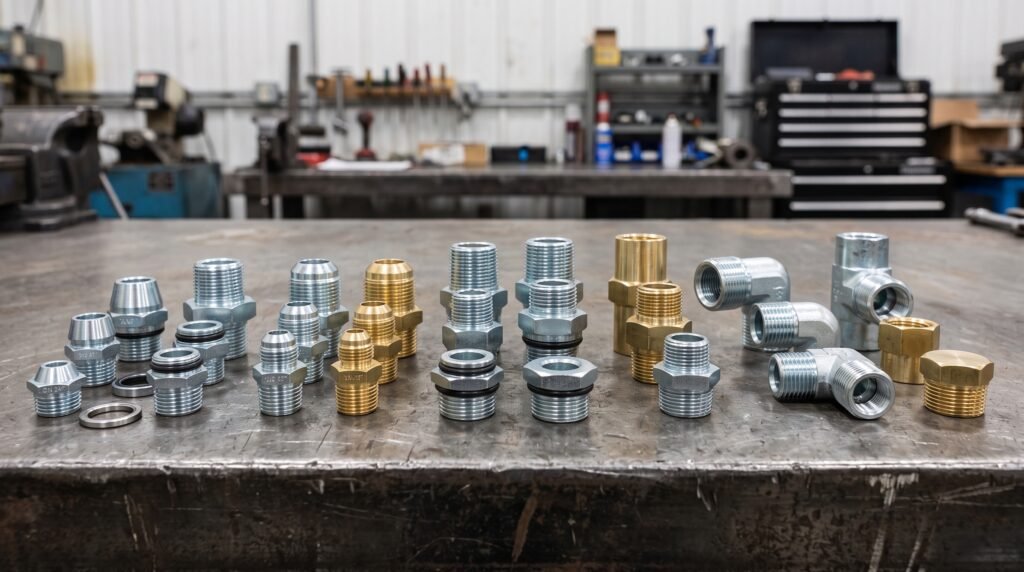
Why a Wrong Thread Match Turns a Good Hydraulic System Into a Leak Point
When a hose assembly, adapter, or port connection does not seal correctly, the cause is often not the hose itself but the thread form behind the connection. NPT, BSP, JIC, ORFS, and metric threads can look almost identical at a glance, especially when parts are dirty, worn, or supplied without clear markings. Accurate hydraulic thread identification helps engineering teams, maintenance technicians, OEM buyers, and distributors avoid mismatched fittings, rework, downtime, and premature leakage in pressure-critical equipment.
Hydraulic thread identification is not only about measuring diameter. A complete check looks at thread type, pitch, taper, sealing method, seat angle, and standard family. For example, JIC and some metric fittings both use straight threads, but their sealing surfaces and seat geometry are completely different. NPT and BSPT are both tapered pipe threads, yet their thread angles and pitch combinations are not interchangeable in a reliable hydraulic circuit.
This guide explains the practical differences between the most common hydraulic thread types and gives a field-ready process for identifying them before you order replacement parts or specify new components. If you are sourcing fittings for production or maintenance, reviewing the right Product category after identification can help narrow the selection faster and reduce costly cross-reference work.
What to Check First: Diameter, Pitch, Taper, and Sealing Surface
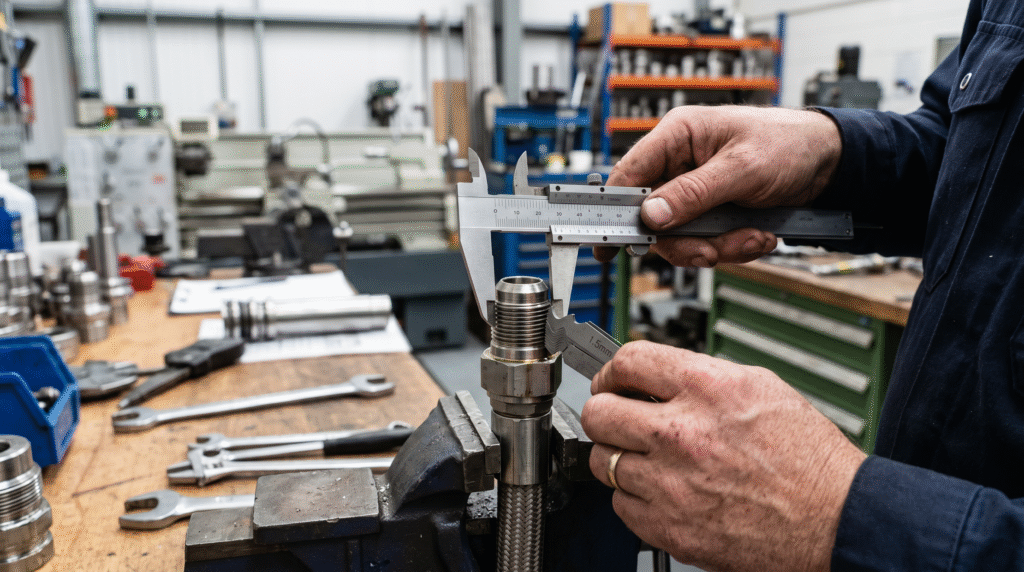
Start with the basic measurements: outside diameter for male threads, inside diameter for female threads, and thread pitch. Use a caliper for diameter and a pitch gauge for thread spacing. For inch threads, pitch is usually expressed as threads per inch, such as 18 TPI. For metric threads, pitch is normally the distance between thread crests in millimeters, such as 1.5 mm. Record both values before naming any thread.
Next, determine whether the thread is tapered or parallel. A tapered male thread becomes slightly smaller toward the end, while a parallel thread maintains the same diameter along its length. Tapered threads typically seal by thread interference with sealant or PTFE tape, while many parallel threads seal on a cone seat, bonded washer, O-ring, O-ring face seal, or machined port surface.
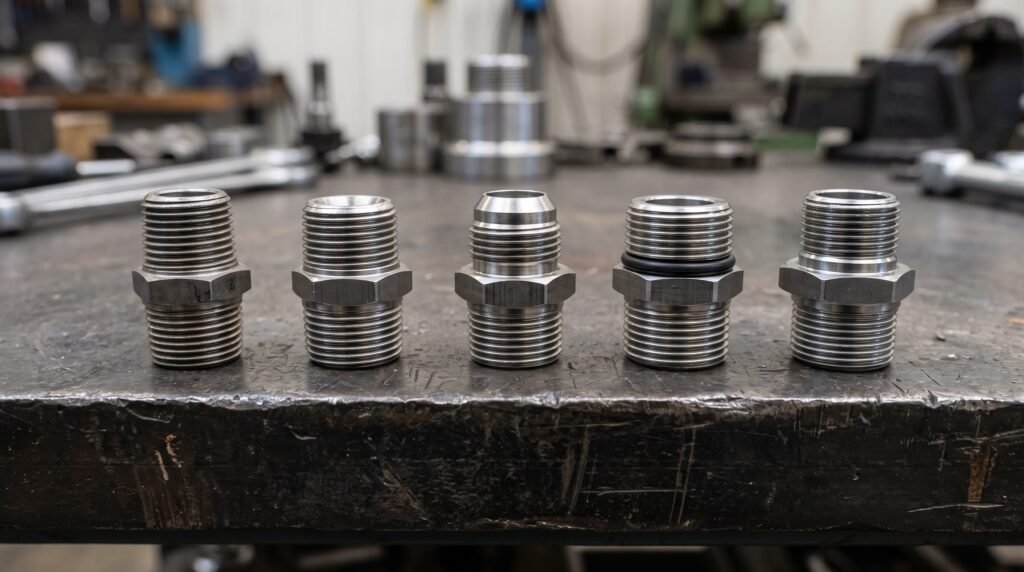
Finally, inspect the sealing area, because this is the detail that separates near-identical standards. A 37-degree flare suggests JIC, a flat face with an O-ring suggests ORFS, a 60-degree cone may point toward certain BSP or metric styles, and a washer seat may indicate BSPP or metric port sealing. Thread identity should never be decided from diameter alone; two standards can share near-identical major diameters but differ in pitch, thread angle, or sealing geometry.
How NPT Threads Work in Hydraulic and Industrial Piping
NPT, or National Pipe Taper, is common in North American hydraulic, pneumatic, and industrial piping applications. The thread is tapered and typically seals by deformation between male and female threads, often with an approved thread sealant. NPT uses a 60-degree thread angle, and sizes are based on nominal pipe size rather than the actual measured thread diameter, which often confuses buyers who are new to pipe threads.
A key identification point is the visible taper. If you measure the male thread diameter near the first full thread and then farther back, the diameter should increase slightly. NPT fittings do not seal at a flare seat or O-ring face; the seal is created entirely in the threads. Because of this, repeated assembly and disassembly can affect sealing reliability if threads are damaged, over-tightened, or contaminated.
NPT should not be forced into BSPT ports even when the first turns seem to engage. The thread angles, pitch combinations, and crest/root forms differ. In high-pressure hydraulic applications, an apparently close fit can still create a spiral leak path or crack a port. For transition points between standards, a properly specified ADAPTER is far safer than relying on partial thread engagement.
BSPP vs BSPT: Why British Standard Pipe Threads Are Confused With NPT
BSP, or British Standard Pipe, appears in many global hydraulic systems, especially equipment built to European, Asian, or international specifications. There are two common forms: BSPP, also called G thread, and BSPT, also called R thread. BSPP is parallel and normally seals with a bonded washer, O-ring, or cone seat. BSPT is tapered and seals through thread interference, similar in concept to NPT but not dimensionally the same.
The main thread geometry difference is decisive: BSP threads use a 55-degree thread angle, while NPT uses 60 degrees. Some sizes may feel close during hand assembly, but the flank contact and sealing behavior are wrong. A BSPT male in an NPT female, or the reverse, can tighten unevenly and leak under vibration, temperature change, or pressure cycling.
To identify BSPP, check for a straight thread and a defined sealing face or washer location. To identify BSPT, measure the taper and compare pitch against a BSP thread gauge. In purchasing documents, avoid writing only “pipe thread,” because that vague term leads to incorrect substitutions. Always use the full standard description, thread size, and sealing style, for example “BSPP G1/2 parallel with bonded seal.”
JIC Fittings: Identifying the 37-Degree Flare Connection Carefully
JIC fittings are widely used in hydraulic hose assemblies and mobile equipment because they are compact, serviceable, and capable of dependable metal-to-metal sealing when correctly selected. The JIC connection uses SAE straight threads for mechanical retention and a 37-degree flare seat for sealing. The threads themselves do not create the hydraulic seal; the cone-to-flare contact does.
The most important inspection step is confirming the seat angle. JIC is 37 degrees, while SAE 45-degree flare fittings are used in other applications and must not be treated as interchangeable. The difference may look small, but a 37-degree male against a 45-degree female contacts incorrectly and can leak or score the sealing surface, leading to repeated failures.
JIC is common in hose ends, adapters, and system transitions. When specifying assemblies, match the hose type, pressure class, fitting style, and crimp requirements as a system rather than as isolated parts. For hose-end selection, categories such as SWAGED HOSE FITTING and ONE PIECE FITTING can be reviewed once the thread and sealing interface are confirmed.
ORFS Connections for High Leak Resistance in Demanding Hydraulic Circuits
ORFS, or O-ring face seal, is designed to provide strong leak resistance in hydraulic systems where vibration, pressure cycling, and cleanliness requirements are critical. The male fitting has a flat face with an O-ring in a groove, and the female side compresses against that face. As with JIC, the straight thread provides clamping force, not the primary seal.
ORFS is relatively easy to identify because of its flat face and visible O-ring groove on the male fitting. If the O-ring is missing, cut, flattened, or incompatible with the fluid, the connection can leak even when the thread size is correct. Maintenance teams should inspect the groove, face finish, and O-ring condition before assuming a fitting needs replacement.
ORFS connections are often selected for applications where oil leakage cannot be tolerated, such as process equipment, marine systems, or machinery operating near sensitive materials. However, ORFS still requires correct torque and clean sealing faces. Dirt trapped on the face can create a leak path, and over-tightening can damage the O-ring or deform the fitting face, so handling discipline matters as much as the connection design.
Metric Hydraulic Threads: DIN, ISO, and JIS Details That Matter
Metric hydraulic fittings are used across global machinery platforms and are often associated with DIN, ISO, and JIS standards. A metric thread is identified by its outside diameter and pitch, such as M18 x 1.5. Unlike inch pipe threads, the nominal designation is much closer to the measured major diameter, which makes caliper and pitch gauge measurements especially reliable for metric hydraulic thread identification.
Metric fittings can seal in several ways, which is why thread size alone is never enough. Some use a 24-degree cone with a cutting ring or soft seal following DIN-style tube fitting practice. Others use a bonded seal, O-ring, flat face, or 60-degree cone depending on the standard. A male M18 x 1.5 thread may not be compatible with every female M18 x 1.5 port if the sealing interface differs.
JIS metric and JIS BSP-related fittings add another layer of complexity for imported equipment. Buyers should check whether the connection is metric straight, BSP-based, flare, cone seat, or flange-related before approving substitutes. When in doubt, provide drawings, photos, measured dimensions, and application details to the supplier instead of relying on a short part description that may hide a sealing mismatch.
A Practical Identification Workflow for Buyers and Maintenance Teams
Use a consistent workflow to reduce errors. First, clean the fitting so the thread crests and sealing surface are visible. Second, identify whether it is male or female. Third, measure the thread diameter. Fourth, measure pitch using the correct inch or metric gauge. Fifth, check whether the thread is tapered or parallel. Sixth, inspect the sealing method: thread seal, flare seat, O-ring face, bonded washer, cone seat, or port seal.
Document the connection in a complete format, such as “male JIC 37-degree flare, 7/16-20,” “BSPP parallel with bonded seal,” or “metric M22 x 1.5 24-degree cone.” This makes purchasing and quality inspection far clearer than recording only an approximate diameter. For OEM and distributor projects, consistent thread documentation also reduces wrong inventory, duplicate part numbers, and emergency cross-reference work.
If a replacement fitting will be used in pressure-critical equipment, confirm material, surface treatment, pressure rating, hose compatibility, and testing expectations as part of the selection process. Thread compatibility is one requirement; real-world performance also depends on manufacturing quality and assembly control. For custom hydraulic solutions or confirmation of a special connection, contact the engineering team through Contact with measurements, photos, and operating conditions.
FAQ
Can NPT and BSP threads be used together?
They should not be treated as interchangeable. NPT uses a 60-degree thread form, while BSP uses a 55-degree thread form. Even if they appear to engage by hand, the seal will be unreliable under hydraulic pressure and can develop a spiral leak path.
How do I know if a hydraulic thread is tapered or straight?
Measure the diameter at two points along the thread. A tapered thread changes diameter along its length, while a straight thread stays nearly constant. Also check the sealing method, because many straight threads seal with an O-ring, washer, cone, or flare instead of the threads themselves.
What is the main difference between JIC and ORFS fittings?
JIC fittings seal on a 37-degree metal flare seat, while ORFS fittings seal on a flat face using an O-ring. Both may use straight threads for retention, but their sealing surfaces are completely different and not interchangeable.
Why does a metric thread size not always guarantee compatibility?
Metric size identifies diameter and pitch, but hydraulic fittings also depend on seat angle, port style, O-ring location, washer sealing, and the applicable DIN, ISO, or JIS standard. Two M18 x 1.5 parts can still be incompatible if their sealing interfaces differ.
What tools are useful for hydraulic thread identification?
A caliper, thread pitch gauge, seat angle gauge, good lighting, and a reliable reference chart are the most useful tools. Clear photos and recorded measurements are also helpful when asking a supplier to confirm a fitting before you order.