
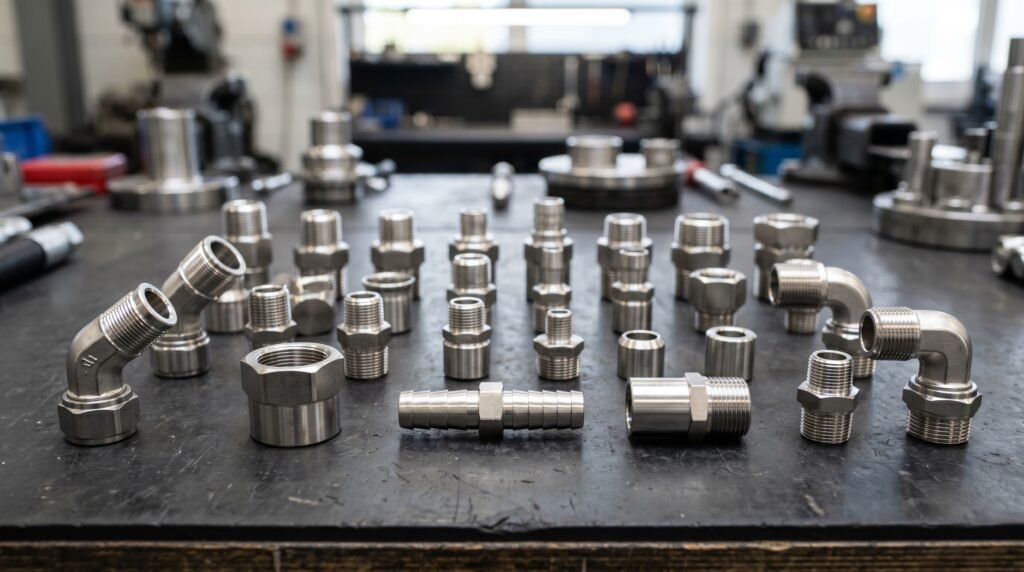
When Corrosion Risk Drives the Fitting Decision
A hydraulic connection is often a small part of the system, yet it becomes the most expensive failure point when the environment is wet, salty, chemically aggressive, or subject to frequent washdown. For maintenance teams and OEM engineers, the decision is not simply whether a fitting will join two components. The real question is whether stainless steel hydraulic fittings can hold sealing performance, thread integrity, and structural strength through repeated pressure cycles and long exposure to corrosive conditions.
Carbon steel fittings remain common in general industrial equipment because they are strong and cost-effective. Stainless steel becomes the better choice when downtime, contamination, rust, or external corrosion creates unacceptable risk. Marine equipment, offshore platforms, chemical processing skids, food and beverage lines, biopharmaceutical utilities, energy systems, and outdoor hydraulic power units often justify the upgrade because the fitting must survive both hydraulic load and environmental attack at the same time.
Selecting stainless does not remove the need for correct engineering. Buyers must still match fitting type, thread standard, sealing method, stainless grade, hose construction, and pressure class. A well-chosen fitting supports stable assembly torque, leak resistance, and serviceability; a mismatched one can create galling on the threads, over-tightening, vibration leaks, or premature hose failure that the stainless material itself cannot prevent.
What Stainless Steel Adds Beyond Basic Strength
The core value of stainless steel is its chromium-rich passive layer, which resists oxidation and many forms of corrosion. In hydraulic service, that resistance protects threaded areas, sealing faces, and crimped connections that would otherwise rust or degrade. This matters most where fittings face salt spray, cleaning chemicals, condensation, or process fluids that attack plated carbon steel surfaces and undermine the zinc or other sacrificial coating.
Stainless steel also supports cleaner operating environments. In food, beverage, pharmaceutical, and bioprocessing areas, visible rust or flaking surface coatings raise hygiene and contamination concerns. While the full assembly must be evaluated against cleanliness requirements, stainless fittings are often preferred because they deliver a durable, corrosion-resistant surface without relying on plating that can chip or wear away over time.
A further advantage is long-term maintenance visibility. Corroded fittings hide cracks, make thread identification difficult, and seize during disassembly, turning a routine repair into a cutting job. Stainless steel reduces these problems when the correct grade is chosen and anti-galling practices are used during installation. For plants standardizing spare parts, stainless fittings can also simplify inventory for equipment that runs across indoor, outdoor, and washdown zones.
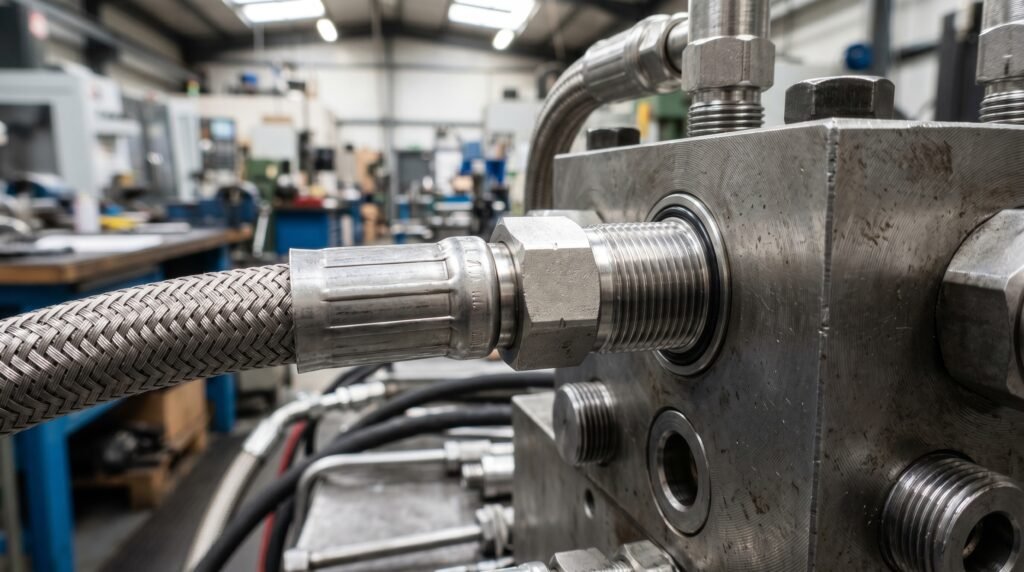
Common Fitting Types in Stainless Hydraulic Assemblies
Stainless hydraulic hose fittings terminate hoses and connect them to pumps, valves, cylinders, manifolds, and instrumentation. Swaged or crimped fittings are among the most common options for high-pressure hose assemblies because they form a controlled mechanical connection between hose, ferrule, and stem. For applications that demand consistent assembly quality, buyers review fitting design together with hose type, crimp diameter, and validation testing. Kaitu Fitting provides dedicated SWAGED HOSE FITTING options for hydraulic hose assembly needs.
Adapters handle transitions between thread forms, port types, tube connections, or orientation requirements. A stainless steel adapter may convert JIC to NPT, metric to BSP, ORFS to metric, or a straight thread to an elbow configuration. Adapters are useful for maintenance and OEM builds, but every added connection introduces a potential leak point, so the best design uses only the transitions that are genuinely needed. Buyers can review typical configurations on the ADAPTER page.
One piece fittings integrate the stem and ferrule into a single component, reducing part handling and helping assembly teams avoid mismatched ferrules. Separate ferrule systems, by contrast, offer flexibility across hose families and assembly requirements. Push-on fittings suit low-pressure applications where quick assembly and serviceability matter, but they should not be substituted into high-pressure circuits unless the hose and fitting system is specifically designed for that use. For a broader view of available categories, see the Product range.
How 304, 316, and Specialty Stainless Grades Compare
304 stainless steel is widely used because it combines good corrosion resistance, formability, and availability. It is often suitable for indoor industrial machinery, general washdown zones, and environments with limited chloride exposure. For buyers upgrading from plated carbon steel to stainless, 304 is a practical starting point when the main concern is atmospheric corrosion rather than aggressive chemical or marine exposure.
316 stainless steel adds molybdenum, which improves resistance to pitting and crevice corrosion, especially in chloride-rich environments. That makes 316 a common choice for marine equipment, offshore systems, coastal facilities, chemical processing, and applications exposed to cleaning agents. If the system sees salt spray, seawater atmosphere, or frequent chemical washdown, 316 is usually evaluated before 304, and the cost difference is often justified by longer service life.
Some applications require other stainless grades or special alloys, depending on fluid compatibility, temperature, pressure, and regulatory expectations. Fitting material should be considered together with hose reinforcement, tube material, valve body, and mating components. Mixing metals is sometimes unavoidable, but designers should account for galvanic corrosion wherever dissimilar metals contact each other and moisture or electrolyte is present.
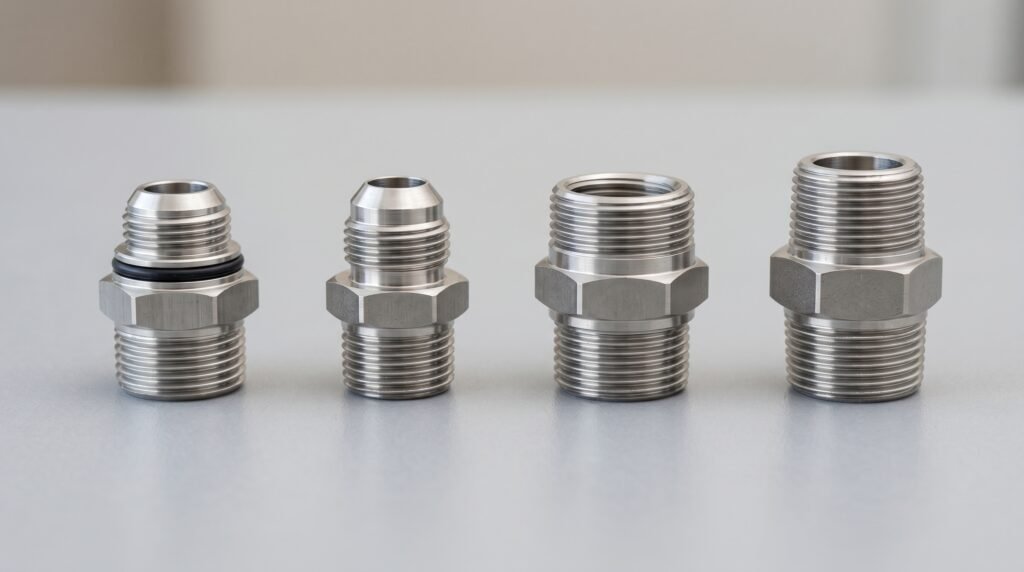
Thread and Sealing Standards That Determine Leak Performance
A stainless fitting can still leak if the thread form or sealing method is wrong. JIC 37-degree flare fittings seal on the metal-to-metal flare seat rather than on the thread. ORFS fittings use an O-ring on a flat face and are valued for high leak resistance in vibration-prone hydraulic systems. NPT threads are tapered and rely on thread interference plus sealant, while BSP, metric, SAE, JIS, and DIN connections each carry their own geometry and sealing expectations that must be matched exactly.
For global OEMs and distributors, standard identification is a major purchasing issue. A part described only as a stainless adapter is not enough. Procurement teams should confirm thread size, pitch, male or female orientation, seat angle, O-ring material where applicable, pressure class, and the governing standard such as DIN, ISO, SAE, JIS, or BSP. A small error in thread pitch can damage ports, produce false torque readings, or cause a leak that appears only under pressure.
Sealing material matters just as much. O-rings and bonded seals must be compatible with the hydraulic oil, synthetic fluid, temperature range, and cleaning chemicals in use. In corrosive environments, the metal may survive while the elastomer fails if compatibility is overlooked. For critical equipment, confirm both the stainless grade and the seal compound before approving a fitting for production or maintenance stock.
Where Stainless Hydraulic Fittings Deliver the Best Return
Marine and offshore systems are among the clearest use cases. Salt exposure accelerates corrosion, and access for repair can be difficult or costly. Stainless fittings are commonly specified for deck machinery, winches, steering systems, hydraulic power units, offshore support equipment, and exposed hose assemblies. In these environments, corrosion resistance contributes not only to service life but also to safer maintenance, because threads and wrench flats remain usable when a repair is needed.
Chemical, energy, and process industries also rely on stainless hydraulic connections where aggressive atmosphere, process vapors, or outdoor installation would shorten the life of plated fittings. Presses, actuators, sampling skids, valve control systems, and hydraulic cylinders may need stainless connections at points exposed to chemical splash or cleaning procedures. In these cases, fitting selection should be coordinated with plant standards and fluid compatibility reviews rather than chosen in isolation.
Food, beverage, and biopharmaceutical facilities often choose stainless fittings in washdown zones and clean production areas. The goal is corrosion resistance plus a cleaner exterior surface and reduced risk of rust-related contamination. OEMs building equipment for these sectors should consider how fittings will be cleaned, whether dead zones are acceptable, and whether the fitting location sits in a hygienic area or a general utility hydraulic circuit.
Selection Checklist for OEMs and Maintenance Teams
Start with the operating conditions: maximum working pressure, pressure spikes, temperature, fluid type, vibration, bend radius, and expected duty cycle. Then define the external environment, including humidity, salt exposure, washdown chemicals, UV exposure, and abrasive contamination. A fitting suitable inside a factory cabinet may be wrong on an outdoor power unit at a port or chemical plant where conditions are far harsher.
Next, match the fitting to the hose or tube system. Confirm hose size, reinforcement type, compatible stem design, ferrule style, and crimp specification if the assembly is swaged. If a separate sleeve is required, the FERRULE must be selected as part of the complete assembly rather than as an independent commodity item. The connection is only as reliable as the compatibility between hose, ferrule, stem, and assembly process.
Finally, document the connection standard clearly for purchasing and maintenance. Include material grade, fitting type, thread standard, seal type, seat angle, and any special requirements. For custom hydraulic solutions, share drawings, samples, operating data, and testing expectations with the manufacturer early. This avoids last-minute substitutions and gives engineering teams enough information to recommend a fitting design that aligns with the full system requirement.
Why Manufacturing Control and Testing Matter as Much as Material
Stainless steel alone does not guarantee a reliable hydraulic connection. Dimensional accuracy, surface finish, thread quality, heat history, machining consistency, and assembly validation all shape performance. A sealing face with poor finish can leak, a thread with inconsistent tolerance can gall or loosen under vibration, and an incorrect crimp profile can damage the hose or reduce retention strength below safe limits.
Industrial buyers should evaluate a supplier’s ability to control production from material selection through machining, inspection, and testing. For hydraulic fittings, relevant checks may include dimensional inspection, thread gauging, pressure testing, impulse testing, salt spray testing where applicable, and visual review of sealing surfaces. Certification systems such as ISO 9001 and IATF 16949 support process discipline, but buyers should still confirm that the supplier understands the specific hydraulic application.
When the application is critical, involve the fitting manufacturer before the design is frozen. Kaitu Fitting manufactures standard and custom hydraulic fitting solutions across multiple standards and industries, with engineering support for product selection and development. If you need help matching stainless fittings to a specific hose assembly, port standard, or operating environment, the Contact page is the right starting point for a technical discussion.
FAQ
Are stainless steel hydraulic fittings always better than carbon steel fittings?
Not always. Stainless steel is preferred for corrosion resistance, washdown, marine, chemical, and clean environments. Carbon steel can be suitable for many general hydraulic systems when corrosion risk is low and cost or strength is the priority.
Should I choose 304 or 316 stainless steel hydraulic fittings?
304 is often suitable for general industrial corrosion resistance and limited chloride exposure. 316 is usually selected for chloride exposure, marine environments, offshore equipment, and frequent chemical washdown because its molybdenum content resists pitting.
What is the difference between JIC and ORFS stainless fittings?
JIC fittings seal on a 37-degree flare seat. ORFS fittings seal with an O-ring on a flat face and are often selected for high leak resistance in vibration-sensitive hydraulic systems.
Can stainless steel fittings be used with carbon steel components?
They can be combined in some systems, but galvanic corrosion should be considered when dissimilar metals are exposed to moisture or electrolytes. Review the full assembly environment before approval.
What information should I provide when ordering custom stainless hydraulic fittings?
Provide drawings or samples, material grade, thread standard, pressure and temperature requirements, fluid type, hose or tube details, seal material needs, and the operating environment.