
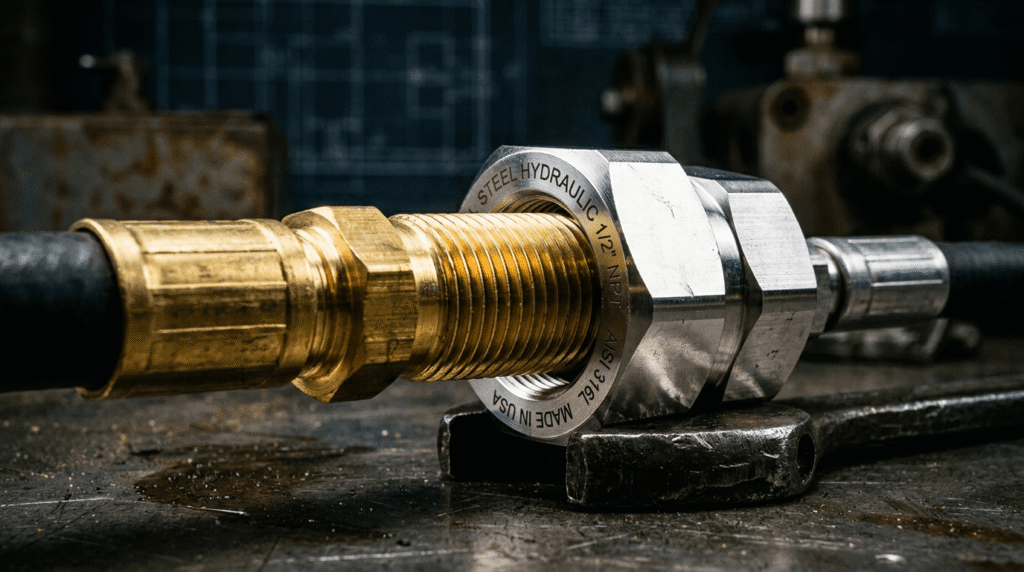
A common scenario in fluid system engineering involves upgrading or repairing an existing line: you have a brass component, but the replacement part available is stainless steel. The immediate question arises: Can you mix brass and stainless steel fittings?
The short answer is mechanically, yes; but chemically, it depends entirely on the environment and the fluid being conveyed. While a brass NPT fitting will thread perfectly into a stainless steel NPT port, putting these two dissimilar metals in direct contact introduces the risk of galvanic corrosion, thread damage, and compromised pressure ratings.
As an industry-leading manufacturer of hydraulic adapters and fluid connectors, Kaitu Fitting frequently guides engineers through complex material selection processes. In this comprehensive guide, we will explore the science behind mixing these metals, identify when it is safe to do so, highlight the critical danger zones (like high-pressure marine hydraulics), and provide best practices for making secure, leak-free connections.
1. The Science of Mixing Metals: Galvanic Corrosion Explained
To understand why mixing brass and stainless steel can be problematic, we must look at the science of galvanic corrosion (often called bimetallic corrosion).
Galvanic corrosion occurs when two dissimilar metals are in direct electrical contact and are bridged by an electrolyte (a liquid that conducts electricity, such as saltwater, unpurified tap water, or acids). In this scenario, the two metals act like a battery.
Metals are ranked on an “Anodic Index” based on their electrochemical nobility:
- Cathode (The Noble Metal): Stainless steel (especially 304 and 316) is highly noble. It will draw electrons from the less noble metal and remain completely protected from rust.
- Anode (The Less Noble Metal): Brass is less noble than stainless steel. In a galvanic reaction, the brass will act as the sacrificial anode, losing mass, weakening, and corroding at a highly accelerated rate.
The Golden Rule: The severity of this corrosion depends almost entirely on the presence of an electrolyte. Without a conductive liquid to bridge the metals, galvanic corrosion cannot occur.
2. When is it SAFE to Mix Brass and Stainless Steel? (Low-Risk Scenarios)
You do not always need to panic if your system mixes these two metals. In several industrial applications, connecting a brass fitting to a stainless steel adapter is perfectly acceptable and will last for years.
A. Dry Compressed Air (Pneumatic Systems)
Air is an insulator, not an electrolyte. If you are threading a brass push-on fitting into a stainless steel manifold for a factory pneumatic system, the risk of galvanic corrosion is virtually zero. As long as the environment remains dry and indoor, the connection is stable.
B. Closed-Loop Hydraulic Oil Systems
This is a critical point for hydraulic engineers: Standard petroleum-based hydraulic oil is a non-conductive dielectric fluid. It does not act as an electrolyte. Therefore, connecting a brass return line fitting to a stainless steel reservoir port inside a dry factory will generally not cause internal galvanic corrosion.
C. Indoor, Climate-Controlled Environments
If the external environment is free from rain, humidity, and chemical vapors, the outside of the fittings will not form the moisture bridge required for the “battery effect” to start.
3. When is it DANGEROUS to Mix Them? (High-Risk Scenarios)
While dry systems are forgiving, introducing conductive fluids or harsh external environments changes the equation entirely. In these scenarios, upgrading to uniform corrosion resistant hydraulic fittings (using all 316 stainless steel) is mandatory.
A. Marine and Offshore Environments
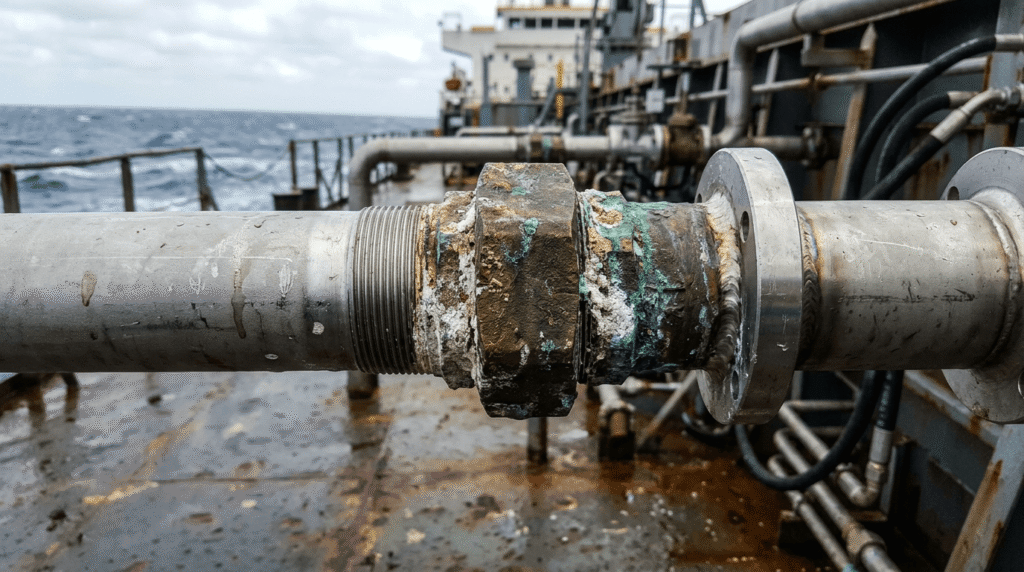
Even if the fluid inside the pipe is non-conductive hydraulic oil, the environment outside the pipe matters. On a ship deck or offshore oil rig, saltwater spray will coat the joint where the brass and stainless steel meet. Saltwater is a highly aggressive electrolyte. The brass fitting will rapidly undergo dezincification, becoming porous, brittle, and eventually failing under pressure.
B. Water Cooling and Plumbing Systems
Tap water, cooling tower water, and especially chlorinated water contain dissolved minerals that conduct electricity. If a brass fitting is threaded into a stainless steel pipe carrying water, the brass threads will corrode and seize over time, leading to leaks that are incredibly difficult to dismantle.
C. Chemical Processing
In environments handling acids, alkalis, or aggressive solvents, mixing metals is strictly prohibited. The chemicals will act as a powerful electrolyte, destroying the brass component within weeks.
4. The Mechanical Challenge: Hardness and Thread Galling
Beyond chemistry, there are physical risks when threading these two materials together.
Mismatched Hardness
Stainless steel is significantly harder than brass. When tightening a stainless steel NPT male adapter into a brass female port, you must be extremely careful. If over-torqued, the hard stainless steel threads will easily cut into, deform, and strip the softer brass threads, ruining the fitting and causing an immediate leak.
Thread Galling Prevention
While brass has natural lubricity, stainless steel is prone to galling (cold welding). When mixing the two, the risk of galling is lower than mixing stainless-to-stainless, but you should still follow proper assembly protocols. Always use a high-quality PTFE (Teflon) tape or a liquid thread sealant on tapered threads (like NPT or BSPT).
5. The Weakest Link: Pressure Ratings
In high-pressure fluid power systems, your system is only as strong as its weakest component.
A premium 316 stainless steel JIC fitting might be rated for 6,000 to 10,000 PSI. However, standard brass fittings are generally only rated for up to 1,000 to 3,000 PSI. If you mix the two in a heavy-duty hydraulic excavator line operating at 4,500 PSI, the brass fitting will structurally fail, deform, or blow out, regardless of corrosion.
For high-pressure lines, stick to matching stainless steel adapters or high-grade carbon steel.
6. Best Practices: How to Safely Mix Brass and Stainless Steel
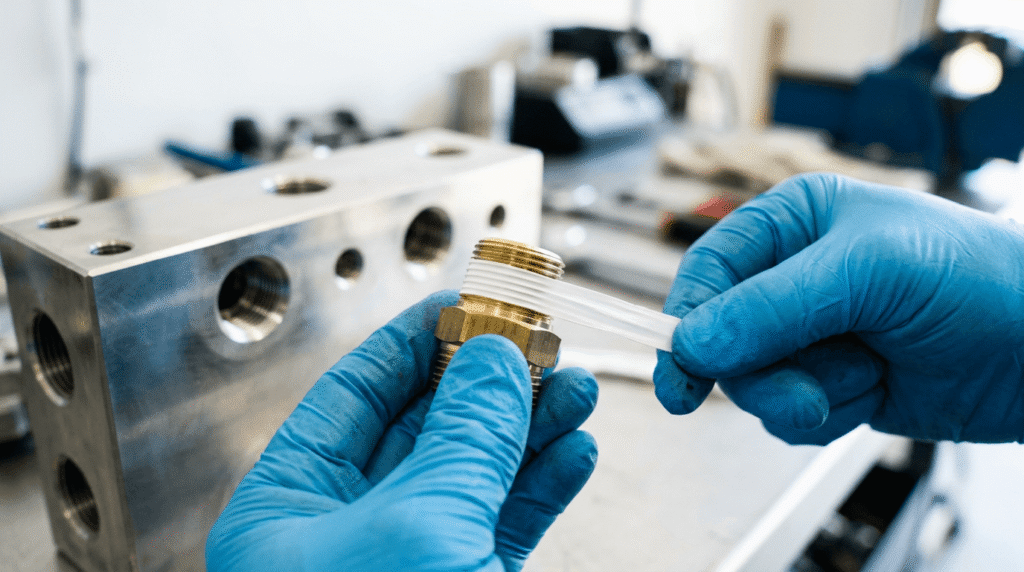
If engineering constraints or emergency repairs force you to mix these metals, follow these industry best practices to mitigate risk:
- Use a Dielectric Barrier: On tapered threads (NPT/BSPT), wrap the male threads generously with PTFE (Teflon) tape. The tape acts as an electrical insulator, preventing direct metal-to-metal contact and disrupting the galvanic circuit.
- Apply Liquid Sealants: Anaerobic thread sealants not only prevent leaks but also coat the threads, reducing electrical conductivity between the two parts.
- Control the Environment: Keep the external joint dry. If the system is outdoors, consider applying a waterproof, anti-corrosion coating or wrapping over the joint to keep moisture out.
- Monitor Regularly: Establish a strict maintenance schedule to inspect the mixed joints for signs of white powdery buildup (zinc oxide) or green discoloration on the brass, which are early signs of galvanic corrosion.
7. Compatibility Matrix: Brass to Stainless Steel Connections
| Fluid / Environment | Is it Safe to Mix? | Primary Risk Factor | Recommendation |
|---|---|---|---|
| Dry Compressed Air | Yes | None (No electrolyte present) | Safe to use. Use PTFE tape for sealing. |
| Hydraulic Oil (Indoor) | Yes | Pressure mismatch. Oil is non-conductive. | Ensure the brass fitting meets the system’s maximum PSI requirements. |
| Fresh Water / Cooling | Moderate Risk | Slow galvanic corrosion over time. | Use dielectric tape; monitor for leaks. Prefer matching materials. |
| Marine / Saltwater (Offshore) | No (High Danger) | Rapid galvanic corrosion and dezincification. | Use 100% 316 stainless steel hydraulic fittings. |
| High-Pressure Hydraulics (>4000 PSI) | No (Mechanical Danger) | Brass blowout due to insufficient tensile strength. | Use matched stainless steel or carbon steel adapters. |
Frequently Asked Questions (FAQ)
Does Teflon tape stop galvanic corrosion between brass and stainless steel?
PTFE (Teflon) tape significantly reduces the risk of galvanic corrosion on threaded connections (like NPT). By wrapping the threads, the tape acts as an electrical insulator, preventing the direct metal-to-metal contact required for the galvanic battery effect to occur. However, it is not a 100% perfect barrier, and in highly aggressive saltwater environments, corrosion may still bridge across the outer exposed surfaces.
Which metal corrodes when brass and stainless steel are mixed?
The brass will corrode. In the galvanic series, stainless steel is the more “noble” (cathodic) metal, while brass is the less noble (anodic) metal. In the presence of an electrolyte like water, the stainless steel remains protected while drawing electrons from the brass, causing the brass to sacrifice itself and rust rapidly.
Can I use brass fittings on a stainless steel hydraulic pump?
If the pump is pushing hydraulic oil (which is not an electrolyte), internal chemical corrosion is unlikely. However, the mechanical danger is the deciding factor. If the pump generates high pressure (e.g., above 3,000 PSI), the brass fitting may lack the tensile strength to handle the stress and could blow out. For high-pressure pumps, you should always use matched stainless steel or carbon steel fittings.
Conclusion: Engineering for Reliability
While you can physically mix brass and stainless steel fittings, the context of your application determines if you should. For indoor pneumatics or low-pressure hydraulic return lines, mixing is generally safe and economical. But if you are dealing with water, marine environments, or extreme high-pressure fluid power systems, mixing metals is an engineering risk that can lead to rapid corrosion and catastrophic failure.
The safest and most reliable engineering practice is to match materials throughout your system. At Kaitu Fitting, we manufacture a comprehensive range of both stainless steel hydraulic adapters and premium brass connectors, ensuring you never have to compromise your system’s integrity.
Not sure which material is right for your exact operating conditions? Contact the engineering team at Kaitu Fitting today. With decades of expertise and strict ISO/IATF quality control, we will help you select the perfect fluid connectors to keep your systems running safely and efficiently.