
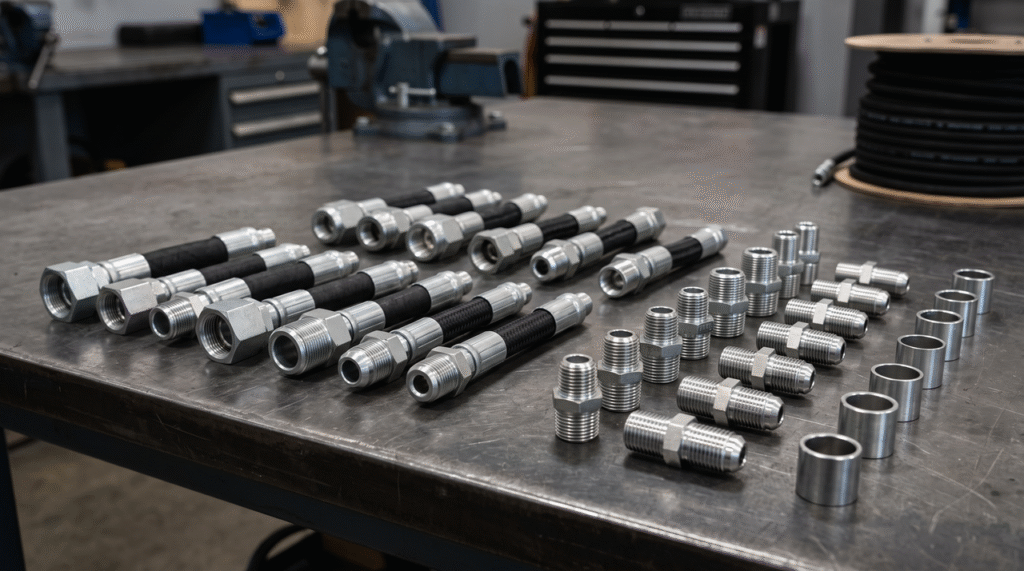
The real decision is assembly control, not fitting style
For purchasing teams, maintenance managers, and OEM engineers, choosing between one-piece and two-piece hydraulic hose fittings looks like a simple product preference. In practice, the decision shapes hose compatibility, crimp accuracy, inventory planning, operator training, downtime risk, and long-term leak performance. A fitting that runs smoothly in one production environment can create problems in another when the hose type, crimping equipment, or service conditions differ.
Hydraulic hose fittings are part of a pressure-containing connection system, not stand-alone components. The hose, stem, ferrule, crimp diameter, thread form, sealing face, fluid type, vibration level, and installation space all interact. A single mismatch can produce weeping, cover damage, premature hose failure, or an assembly that passes initial inspection but fails under pressure cycling.
Both one-piece and two-piece fittings deliver reliable performance when specified and assembled correctly. The better choice depends on whether your operation values simplified assembly and fewer components, or broader flexibility across hose styles and field conditions. Understanding the trade-offs lets buyers standardize intelligently instead of selecting fittings by habit or unit price alone.
What sets a one-piece hose fitting apart on the production floor
A one-piece hose fitting combines the stem and ferrule into a single integrated component. The operator inserts the hose and crimps the assembly to the correct specification. Because the ferrule is already matched to the stem design, one-piece fittings cut the number of loose parts that must be selected, staged, and verified before crimping.
This structure pays off where speed, repeatability, and error reduction matter most. OEM hose assembly lines, distributor workshops, and maintenance teams producing many similar assemblies benefit from fewer part numbers at the workbench and less chance of pairing the wrong ferrule with the wrong stem. For many standard hoses, a ONE PIECE FITTING can streamline assembly while holding consistent crimp geometry across every unit.
The integrated design also supports cleaner inventory control. Instead of managing separate bins for stems and ferrules, buyers stock a complete fitting in each required thread type, angle, and hose size. That simplifies picking, reduces kitting mistakes, and makes visual inspection easier for supervisors. The same integration, however, reduces flexibility when an operation frequently changes hose constructions or must adapt fittings to unusual cover thicknesses.
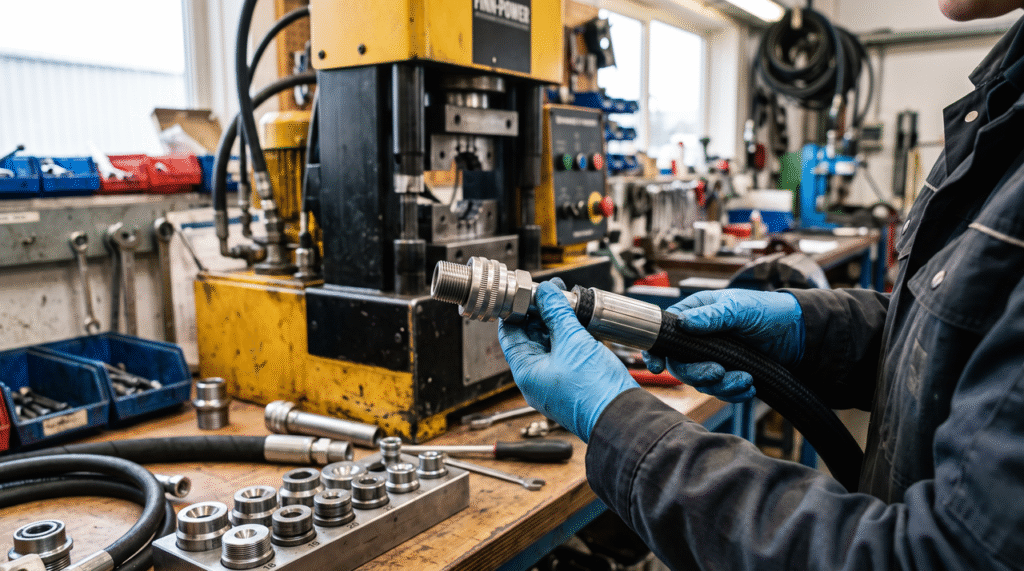
Why two-piece fittings stay valuable for flexible hose programs
A two-piece fitting uses a separate stem and ferrule. The assembler selects the stem connection type and pairs it with a ferrule suited to the hose construction. This adds one selection step, but it delivers greater flexibility when working across multiple hose brands, cover types, reinforcement styles, or special application requirements.
Two-piece systems are common in repair operations, mixed-fleet maintenance, and applications where the same stem type must work with different ferrules. A maintenance team supporting mobile equipment, industrial presses, agricultural machinery, and plant hydraulic systems often encounters hoses with different outside diameters even when the nominal inside diameter is the same. A separate FERRULE lets the assembly program match the actual hose body rather than forcing a single integrated part.
This flexibility is an advantage when engineers validate a new hose program or when distributors serve customers spanning DIN, ISO, SAE, JIS, BSP, JIC, NPT, or ORFS connections. The trade-off is that the selection process must be controlled. Operators need clear crimp charts, verified hose-ferrule compatibility, and disciplined part identification. Without that control, two-piece systems introduce assembly variation that shows up as leaks under pressure.
One-piece vs two-piece hydraulic hose fittings at a glance
| Factor | One-piece fitting | Two-piece fitting |
|---|---|---|
| Component structure | Stem and ferrule are integrated | Stem and ferrule are selected separately |
| Assembly speed | Generally faster for repeat production | May take longer due to ferrule selection |
| Inventory handling | Fewer loose parts at the assembly station | More component flexibility but more SKUs to manage |
| Best fit | Standardized OEM and distributor hose programs | Repair, mixed-fleet, and variable hose applications |
| Main risk | Less flexibility if hose construction changes | Incorrect ferrule-stem-hose pairing |
| Quality control focus | Crimp diameter, insertion depth, orientation | Compatibility check plus crimp and insertion inspection |
How crimping accuracy changes the performance equation
Crimping is where fitting design becomes functional performance. The crimp must compress the ferrule enough to grip the hose reinforcement and seal against the stem, but not so aggressively that it damages the hose structure. Both one-piece and two-piece fittings demand the correct die set, crimp diameter, insertion depth, and inspection method.
One-piece fittings usually make crimping more straightforward because the ferrule is already part of the fitting. This removes the risk of using an incompatible ferrule, especially in fast-moving production, and it shortens operator training because there are fewer component combinations to learn. For repeat assemblies, that consistency is a measurable advantage.
Two-piece fittings require more attention before crimping. The operator must confirm the selected ferrule suits the hose type and that the stem is inserted to the specified depth. Managed well, two-piece assemblies perform very reliably. Managed poorly, small selection errors create large consequences under pressure, vibration, impulse loading, or temperature cycling.
In either system, quality control should include visual checks, measurement of crimp diameter, verification of fitting orientation, and testing when the application requires it. For high-volume production or safety-critical assemblies, documented procedures matter more than fitting style alone.
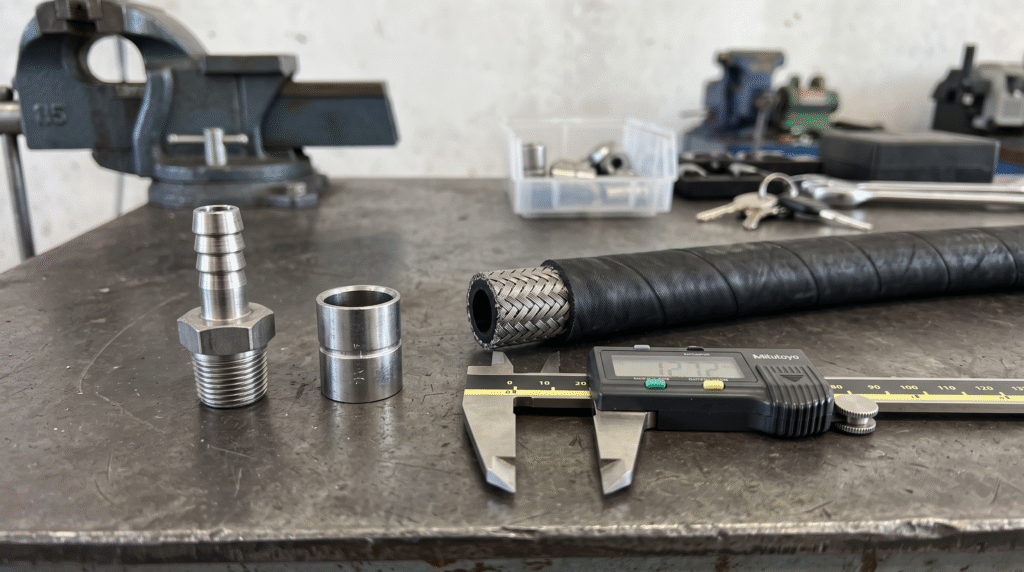
Where each fitting type performs best in industrial applications
One-piece fittings are often preferred where the hose range is controlled, production volume is steady, and repeatability is the priority. OEM manufacturing lines, standardized machinery platforms, and distributor assembly cells gain from faster picking and fewer component decisions. Here the value is not just assembly speed; it is the reduction of avoidable variation across thousands of assemblies.
Two-piece fittings are strong candidates where application diversity is high. Mobile service teams, hydraulic repair centers, and plants with mixed equipment must handle different hose constructions, older machinery, imported thread standards, and non-standard replacement situations. The ability to select a ferrule independently makes the two-piece system more adaptable to what actually arrives at the bench.
Connection style also matters. Whether the assembly uses JIC, BSP, metric, NPT, ORFS, flange, or other interfaces, the sealing method must match the port or adapter. When the hose assembly connects into a larger hydraulic circuit, related components such as an ADAPTER may be needed to transition between thread forms or sealing systems. Fitting choice should therefore be reviewed as part of the complete connection path, not the hose end in isolation.
For harsh environments, weigh corrosion exposure, abrasion, routing stress, cleanliness requirements, and maintenance access. A fitting that is easy to crimp but hard to install correctly inside the machine can still create long-term service problems.
When inventory strategy should drive your fitting choice
Inventory is one of the most practical reasons companies standardize on a single fitting system. One-piece fittings cut the number of assembly components and simplify warehouse management. This helps when a company produces consistent hose assemblies and wants faster picking, easier barcode control, and less risk of incomplete kits reaching the crimping station.
Two-piece fittings can increase the number of stocked items because stems and ferrules are managed separately. That is not always a disadvantage. In a broad service program, separate ferrules improve coverage across hose types without requiring a distinct one-piece fitting for every combination. The best inventory strategy depends on whether your demand is concentrated or highly varied.
Buyers should also weigh slow-moving stock. A one-piece fitting bought for a very specific hose and thread combination can sit unused if demand shifts. In a two-piece system, some stems or ferrules serve multiple assemblies, depending on compatibility, which improves stock utilization—but only when the organization maintains accurate part data and clear assembly rules.
A practical method is to analyze the previous 6 to 12 months of hose assembly demand by hose size, fitting end, angle, thread standard, and equipment platform. High-volume repeat items are strong candidates for one-piece standardization, while low-volume or variable items usually stay better suited to two-piece assemblies.
Practical selection checklist for buyers and engineers
| Question | Why it matters |
|---|---|
| Is the hose type standardized across the program? | Standardization often supports one-piece fitting efficiency. |
| Do operators assemble many different hose constructions? | Variation may justify the flexibility of a two-piece system. |
| Are crimp specifications clearly documented? | Correct crimping is essential for safe sealing and retention. |
| Are thread standards verified before ordering? | Misidentified threads can cause leakage or installation damage. |
| Is inventory demand concentrated or unpredictable? | Demand patterns affect whether integrated or separate components are easier to manage. |
| Will the assembly face vibration, heat, abrasion, or corrosion? | Service conditions influence fitting material, routing, and validation needs. |
What engineers must verify before approving a hose assembly
Engineering approval should start with the operating conditions. Pressure rating, impulse frequency, fluid compatibility, temperature range, bend radius, movement, and external abrasion all affect fitting selection. The fitting must suit both the hose and the system, and the finished hose assembly should be validated against the application requirements.
Thread identification is another frequent source of failure. Similar-looking threads can differ in angle, pitch, sealing method, or seat design. JIC and SAE, BSPP and BSPT, metric light and heavy series, NPT, and ORFS connections should never be assumed interchangeable. Misidentification may allow partial installation yet cause leakage, thread damage, or unsafe operation. When the thread form is uncertain, confirm it before ordering or assembling components.
Material and surface treatment also deserve review. Carbon steel, stainless steel, and other options are chosen for corrosion exposure, fluid type, and environmental conditions—driven by actual service conditions rather than general preference. Teams should also check whether the assembly will sit near heat sources, moving parts, or areas where impact damage is likely.
Finally, documentation matters. Keep records of hose type, fitting part number, ferrule selection where applicable, crimp specification, inspection results, and test requirements. This information supports repeatability, root-cause analysis, and lifecycle performance tracking, which is especially valuable for OEMs and industrial fleets.
Choosing a supplier that supports more than the fitting itself
A reliable fitting program depends on component quality, manufacturing consistency, technical support, and application knowledge. Industrial buyers should look for suppliers that support both standard and custom hydraulic solutions, provide clear product categories, and understand the international standards used in hydraulic systems. A broad Product range makes it easier to standardize hose ends, adapters, ferrules, and related connection components through one source.
For swaged assemblies, the relationship between hose, stem, ferrule, and crimping process is critical. Reviewing the available SWAGED HOSE FITTING options helps buyers align assembly needs with the right fitting structure. If your application calls for unusual thread combinations, tight routing, or a transition between standards, early supplier involvement can prevent costly redesigns later.
When comparing suppliers, ask practical questions: Can they support DIN, ISO, SAE, JIS, BSP, JIC, NPT, or ORFS requirements? Can they review drawings or samples? Do they provide manufacturing and testing support appropriate for industrial use? Can they discuss lifecycle performance instead of only quoting a part number? These questions matter most for OEMs, distributors, and maintenance teams that need repeatable leak-proof performance across many assemblies.
When the application is new, safety-critical, or hard to identify, consult before ordering. Sharing hose details, operating pressure, thread requirements, fluid type, temperature, equipment model, and installation photos lets a technical team recommend a more accurate solution. For project support or custom hydraulic connection requirements, buyers can reach out through the Contact page.
FAQ
Are one-piece hydraulic hose fittings always better than two-piece fittings?
No. One-piece fittings are often better for standardized, repeat production because they reduce component selection errors. Two-piece fittings can be better when hose types vary or when more ferrule flexibility is needed.
Can the same crimp setting be used for one-piece and two-piece fittings?
Not unless the fitting, hose, and manufacturer’s crimp specification confirm it. Crimp diameter, die selection, and insertion depth must be matched to the exact assembly components.
When should a maintenance team choose a two-piece fitting system?
A two-piece system helps when the team services mixed equipment, uses different hose constructions, or needs to match ferrules to varying hose outside diameters and reinforcement styles.
Do one-piece fittings reduce inventory cost?
They can simplify inventory by combining stem and ferrule into one item, but the best result depends on demand patterns. High-volume repeat assemblies usually benefit most from one-piece standardization.
What information is needed to specify the correct hydraulic hose fitting?
Key information includes hose size and type, working pressure, fluid, temperature, thread standard, sealing method, fitting angle, material requirements, and the crimping or assembly process.