
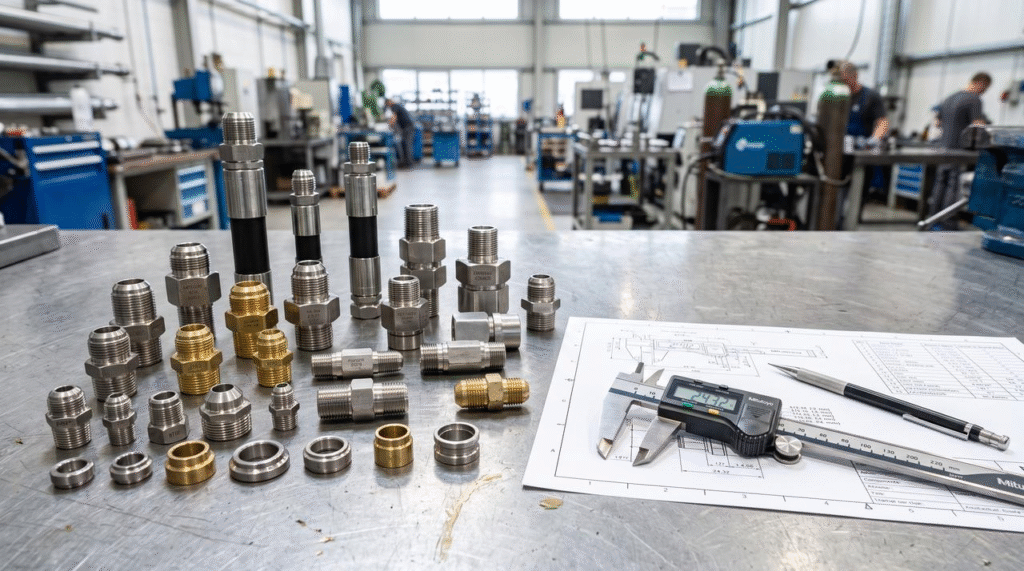
Define the Application Before You Compare Hydraulic Fittings Manufacturers
Choosing among hydraulic fittings manufacturers is not simply a matter of comparing catalogs or unit prices. The more important decision is whether a supplier can consistently deliver a connection that matches the hose, pressure, temperature, fluid, installation method, and operating environment of the finished machine. A fitting that appears correct but uses the wrong thread standard, sealing method, or material can create leakage, downtime, contamination, or premature hose failure long after the purchase order is closed.
Industrial buyers should define the application before requesting a quotation. Record the hose construction and inside diameter, working and peak pressure, temperature range, fluid compatibility, motion or vibration, installation space, connection type, and expected service life. For chemical processing, marine, offshore, food and beverage, and biopharmaceutical equipment, also consider corrosion exposure, cleanliness requirements, washdown chemistry, and the consequences of a leak in a regulated or occupied environment. This information allows a manufacturer to recommend a suitable configuration rather than merely matching a product image.
The right sourcing process separates three questions: can the fitting be produced, can it be produced consistently, and can the supplier document that it meets the application requirements? A capable Chinese manufacturer may support standard and custom configurations, but the purchaser still needs to verify drawings, specifications, samples, inspection records, and communication procedures before approving production. Treating these as three distinct hurdles prevents a supplier that clears the first from being assumed to clear the other two.
How Thread and Sealing Standards Shape Fitting Selection
Hydraulic fittings are commonly specified against regional or industry-recognized systems such as DIN, ISO, SAE, JIS, BSP, JIC, metric, NPT, NPTF, ORFS, and flanged standards. These designations can describe thread geometry, sealing method, dimensional relationships, or connection style. They should not be treated as interchangeable labels. For example, a metric thread and a similarly sized inch thread may engage incorrectly, while two fittings with different sealing faces may appear compatible until the system is pressurized and one joint weeps or blows out.
When reviewing a supplier, ask which standard controls the complete connection: the fitting, mating port, hose-end geometry, seal, and installation tooling. Request dimensional drawings or controlled product data for non-obvious combinations. Thread identification is especially important when replacing imported equipment or consolidating components from multiple regions. A useful starting point is this guide to hydraulic thread identification, followed by confirmation against the equipment manufacturer’s documentation and, where possible, a physical thread gauge and seat check.
Quality certification can indicate that a supplier operates a documented management system, but it is not a substitute for product-specific validation. Kaitu Fitting identifies itself as ISO 9001- and IATF 16949-certified, which is relevant when procurement teams need evidence of structured quality processes and automotive-grade quality management practices. Buyers should still ask how incoming materials, machining, forming, assembly, marking, inspection, nonconforming products, and corrective actions are controlled for the exact parts being purchased, not for the plant in general.
Match Fitting Material to Pressure, Corrosion, and Cleanliness
Material selection should follow the environment rather than habit. Steel and carbon steel fittings may suit many general industrial hydraulic applications when strength, availability, and cost control are priorities. Stainless steel is often considered for corrosive, washdown, marine, offshore, chemical, and demanding process environments, although the exact grade, surface condition, fluid, and exposure must be reviewed together. Brass and aluminum can be appropriate in selected applications where their mechanical and corrosion characteristics align with the system requirements and pressure class.
The fluid itself matters. Hydraulic oil, water-based fluids, aggressive chemicals, gases, cleaning agents, and process media can attack both the fitting body and the sealing elements. Temperature cycling may also change seal behavior and joint performance over time. A supplier should receive the fluid type, concentration where relevant, temperature range, and cleaning method before recommending a material or finish. If the equipment operates in a salt-laden or outdoor environment, include galvanic compatibility between the fitting, hose ends, tubes, and connected equipment, since dissimilar metals in contact can corrode faster than either would alone.
Material traceability is particularly useful for critical equipment and regulated or contamination-sensitive applications. Clarify whether certificates, batch identification, material declarations, dimensional inspection reports, or other records are available for the order. Do not assume that a material name alone establishes suitability; the final decision should consider pressure design, corrosion resistance, machining quality, sealing surfaces, installation practices, and the applicable customer or industry specification.
Match the Fitting Construction to Your Assembly Method
Swaged hose fittings are designed to be permanently attached to compatible hose assemblies using the specified ferrule, die, and crimping procedure. They are widely used where a controlled assembly process and repeatable connection are required. The hose, fitting, and ferrule must be treated as one engineered combination; mixing components from different systems can change the crimp diameter and compromise retention or sealing, even when the parts appear to thread and seat together.
One-piece fittings combine the fitting and ferrule in a single configuration, which can simplify component selection and reduce the chance of pairing an incompatible ferrule. They may be useful for production environments seeking a consistent assembly workflow and fewer stocked part numbers. Separate ferrules remain valuable when the hose construction and assembly system call for them, but the correct ferrule profile, material, and crimp specification must be confirmed before use.
Adapters solve a different problem: they connect ports or components with different thread forms, sizes, orientations, or connection styles. They are useful for equipment integration and replacement projects, but each additional joint introduces another potential leak path and increases envelope size. Push-on fittings can support suitable low-pressure or designated push-on hose applications, while high-pressure systems require careful confirmation that the fitting and hose construction are approved for the intended duty. Kaitu’s product range includes these categories, allowing buyers to compare the construction most appropriate for the assembly process.
Connection Standards to Verify Before Ordering
| Connection family | What to confirm | Typical buyer concern |
|---|---|---|
| DIN and ISO | Thread, dimensions, sealing arrangement, and applicable series | Compatibility with metric or European equipment |
| SAE and JIC | Thread size, flare or sealing geometry, and mating port | Correct fit on North American or mobile equipment |
| BSP | BSPP or BSPT form, size, and sealing method | Avoiding confusion between parallel and tapered threads |
| NPT and NPTF | Thread form, sealant requirements, and mating port | Preventing incorrect substitution with other tapered threads |
| ORFS and flanged | O-ring, face-seal, flange pattern, size, and pressure application | Reliable sealing in higher-demand hydraulic systems |
| JIS and metric | Thread pitch, port geometry, and equipment standard | Replacement of components on Asian-manufactured machinery |
Standards and Connection Families to Confirm Before Ordering
A purchasing specification should identify both ends of the fitting, not just the general product family. State the hose-end type, port-end type, nominal size, thread or flange standard, sealing arrangement, material, finish if relevant, orientation, and quantity. Include a drawing for unusual geometry or tight installation spaces. This prevents a quotation from being based on an assumed thread or an image that does not show the complete connection, which is one of the most common causes of a wrong first order.
The table below provides a practical screening framework. It is not a substitute for dimensional verification, because similar-looking threads and seals can differ substantially between standards. For replacement parts, compare the original part number, port measurement, thread form, sealing face, and application documentation before approving an alternative.
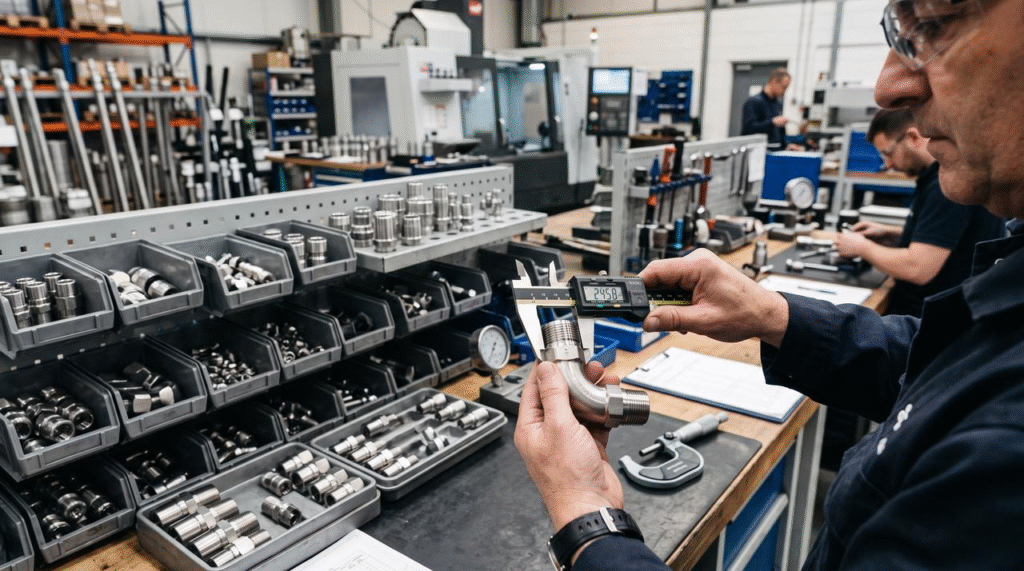
Why Production Capability Matters More Than Catalog Size
A broad catalog is useful only when it is supported by repeatable production and engineering control. When assessing a Chinese manufacturer, investigate whether key operations are managed in-house or coordinated through external suppliers. Relevant capabilities may include precision machining, forming, ferrule production, hose assembly, surface treatment, marking, dimensional inspection, and pressure testing. In-house control can improve communication and consistency, while outsourced processes require clear responsibility and traceability at each transfer point.
Ask how the supplier converts a customer drawing or sample into a controlled production part. The process should address drawing review, revision control, material confirmation, first-article approval, tooling or crimp parameters, inspection points, packaging, and change notification. For custom hydraulic configurations, clarify which dimensions are fixed, which may be optimized by engineering, and who owns approval of the final design so that no dimension is changed without sign-off.
Testing should reflect the actual risk. Pressure testing can help identify leakage or structural problems, but the purchaser should ask what test method, sample quantity, pressure basis, duration, acceptance criteria, and records apply. Testing alone cannot correct an unsuitable design or an incorrect thread. A robust quality approach combines design review, material and dimensional control, assembly validation, visual inspection, and appropriate pressure testing. Kaitu describes rigorous pressure testing and lifecycle performance tracking as part of its solutions-oriented approach, which buyers can explore further through its hydraulic hose fittings information.
A Due-Diligence Checklist for Comparing Suppliers
Before placing a production order, compare suppliers using evidence rather than marketing language. Request a current company profile, applicable quality certifications, product drawings, material options, manufacturing locations, inspection approach, sample procedure, packaging method, and expected documentation. If the application is safety-critical or difficult to service, ask for a technical contact who can review the complete hose and fitting assembly instead of responding only to a part number.
Samples are most useful when they are tested against a defined approval plan. Check thread engagement, sealing faces, surface finish, dimensions, markings, ferrule fit, crimp or assembly results, and compatibility with the intended hose and mating port. Record the sample revision and approval status. If free samples are offered, confirm whether the sample is representative of normal production and whether the same material and process will be used for volume orders, since a hand-finished sample and a production lot can differ.
Commercial evaluation should include more than the quoted piece price. Consider tooling, minimum order conditions, packaging, shipping method, lead-time communication, inspection costs, nonconformance handling, documentation, and the cost of field replacement. A supplier with engineering support and a controlled custom-product process may reduce total project risk even when another quotation appears lower at the component level. Kaitu’s Contact page can be used to submit application details for a more informed technical discussion.
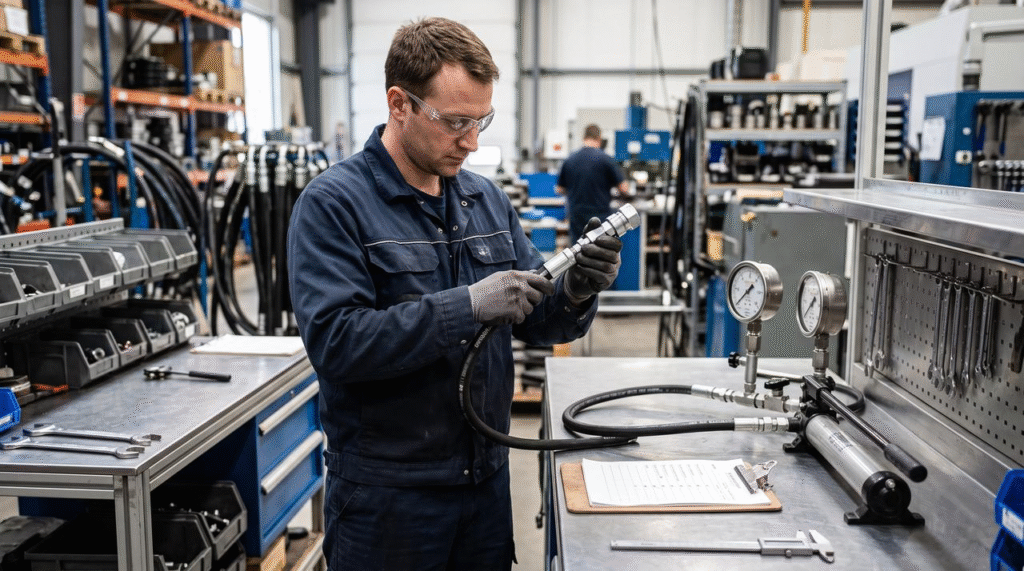
Hydraulic Fittings Supplier Evaluation Checklist
| Evaluation area | Evidence to request | Why it matters |
|---|---|---|
| Quality system | Applicable certification and documented quality procedures | Shows whether production controls are structured and repeatable |
| Technical capability | Drawings, engineering review, materials, and custom-production process | Reduces errors in nonstandard or integrated assemblies |
| Testing | Test method, acceptance criteria, sample basis, and records | Connects pressure validation to the actual product risk |
| Sample approval | Representative samples, inspection results, and revision control | Confirms that production intent matches the approved design |
| Traceability | Lot identification, material records, and nonconformance process | Supports investigations and controlled replacement programs |
| After-sales support | Technical contact, change notification, and issue-response process | Helps manage lifecycle performance and field problems |
Build a Specification That Prevents Ordering Errors
A clear request for quotation should begin with the application and end with acceptance criteria. Include a part number or drawing, quantity by release, hose specification, connection standards, material, finish, orientation, pressure and temperature requirements, fluid, packaging needs, and required documentation. State whether the item is a replacement, a new design, or part of a validated assembly. Photographs can help explain orientation, but they should support rather than replace dimensional information.
For hose assemblies, specify the hose manufacturer or exact hose series when the fitting system depends on compatibility. Identify the required crimp diameter or assembly method only when it has been validated for that hose and fitting combination. Ask the supplier to flag any conflict between the requested fitting and the hose construction instead of silently substituting a similar component, and make that requirement explicit in writing.
Finally, define how changes will be managed. Material substitutions, thread changes, plating or surface-treatment changes, tooling changes, and relocation of production can all affect fit or performance. A written approval process, retained sample, inspection plan, and lot identification make future investigations easier. These controls are valuable for distributors maintaining several customer configurations as well as for OEMs integrating fittings into repeat-production equipment.
From First Sample to Lifecycle Performance
Supplier selection should continue after the first shipment. Track leakage, assembly difficulty, crimp consistency, corrosion observations, field returns, and replacement intervals by part number and application. Trend data can reveal whether a problem originates in fitting geometry, hose selection, installation tooling, torque, routing, vibration, contamination, or operating conditions rather than in the fitting alone. Lifecycle tracking also helps procurement teams decide where standardization is beneficial and where a custom configuration is justified.
Engineering support is especially important when a fitting must accommodate limited space, unusual orientation, multiple standards, or demanding environmental conditions. A manufacturer with more than 1,000 standard and custom options across brass, steel, stainless steel, carbon steel, and aluminum may be able to consolidate several connection requirements into fewer part numbers, but the final choice should remain tied to verified performance and compatibility rather than catalog breadth alone.
For a new project, a practical sequence is to define the duty, identify the connection standards, shortlist capable manufacturers, request drawings and samples, validate the assembly, approve documentation, and then monitor production lots and field performance. Kaitu’s dedicated pages for swaged hose fittings and adapters provide useful starting points for comparing common configurations. The goal is not simply to find a fitting that connects; it is to establish a controlled, leak-resistant connection that remains suitable throughout the equipment’s service life.
FAQ
What should I provide when requesting a hydraulic fitting quotation?
Provide the hose specification, fitting type, port and hose-end standards, size, material, pressure, temperature, fluid, orientation, quantity, and any drawing or sample. Include the operating environment and required inspection or documentation.
Are DIN, SAE, JIC, BSP, and NPT fittings interchangeable?
No. These systems can differ in thread form, pitch, sealing method, and dimensions. Confirm the complete connection and use dimensional drawings or verified thread-identification information before substitution.
How do I evaluate a Chinese hydraulic fittings manufacturer?
Review quality certifications, manufacturing and engineering capabilities, material controls, drawings, sample procedures, pressure-testing methods, traceability, change control, communication, and evidence that production parts match approved samples.
When should I choose stainless steel hydraulic fittings?
Consider stainless steel when corrosion exposure, marine or offshore service, washdown, chemical contact, or cleanliness requirements make it appropriate. Confirm the exact material, fluid compatibility, temperature, pressure, and mating-component compatibility.
Why are hose, fitting, and ferrule compatibility important?
The assembly is engineered as a system. The hose construction, fitting geometry, ferrule, tooling, and crimp or assembly procedure determine retention and sealing. Mixing components without validation can create leakage or premature failure.