
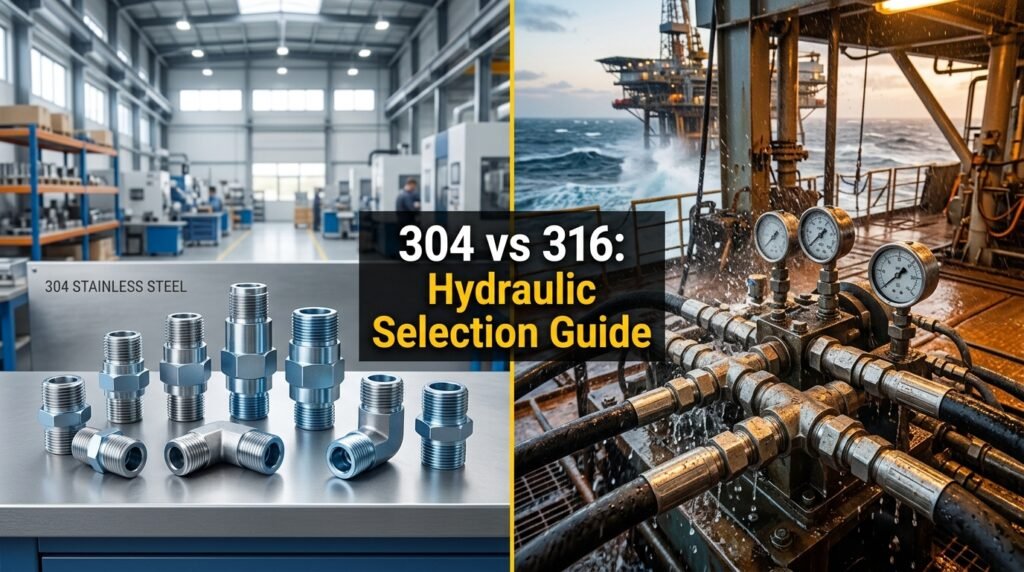
Choosing between 304 and 316 stainless steel fittings usually comes down to corrosion resistance, operating environment, and total cost. For standard indoor hydraulic systems, 304 stainless steel is often enough. For marine, chemical, offshore, or high-chloride environments, 316 stainless steel is usually the safer choice because it contains molybdenum, which improves resistance to pitting and crevice corrosion.
For procurement managers and fluid system engineers, selecting the correct grade for your stainless steel hydraulic fittings is critical. A miscalculation can lead to catastrophic system leaks under high pressure, while over-engineering can unnecessarily inflate project budgets. As a professional manufacturer of hydraulic adapters and fluid connectors, Kaitu Fitting has compiled this comprehensive guide to help you navigate the technical nuances of these two indispensable materials.
Stainless Steel vs Carbon Steel Fittings: When to Choose Which?
Before diving into the differences between the 300-series grades, a common question arises during system design: stainless steel vs carbon steel fittings—which is the better investment?
Carbon steel fittings are significantly cheaper and offer excellent tensile strength. If your hydraulic system operates indoors, uses standard petroleum-based hydraulic fluid, and is completely protected from moisture or corrosive vapors, carbon steel is the most economical choice. However, carbon steel will rust rapidly when exposed to water, condensation, or aggressive chemicals.
You must upgrade to corrosion resistant hydraulic fittings (like 304 or 316) when:
- The system operates outdoors or in harsh weather conditions.
- The fluid being conveyed is water-based, acidic, or caustic.
- The environment requires strict hygiene and wash-downs (e.g., food and beverage, pharmaceuticals).
- The application is offshore, marine, or coastal.
Understanding 304 Stainless Steel Fittings in Hydraulic Systems
Type 304 is the industry workhorse and the most widely used grade for general-purpose 304 stainless steel fittings. It contains roughly 18% chromium and 8% nickel, providing a strong passive oxide layer that resists typical atmospheric corrosion.
Best Applications for 304 Hydraulic Adapters
In the realm of fluid power, 304 is exceptionally versatile. It is the go-to material for indoor, standard-pressure hydraulic lines where the primary requirement is clean, rust-free operation without exposure to heavy salts or industrial solvents.
- Standard Industrial Hydraulics: Factory automation, injection molding machines, and indoor material handling equipment.
- Pneumatic Systems: Compressed air lines where moisture might be present.
- Cooling Systems: Transporting fresh water or glycol mixtures.
The Limitation: 304 stainless steel is vulnerable to chlorides (salts). If you use a 304 fitting on a ship’s deck or a coastal oil rig, the salt will strip away the chromium oxide layer, leading to rapid pitting and crevice corrosion.
The Superiority of 316 Stainless Steel Fittings
When the environment gets hostile, 316 stainless steel fittings become mandatory. Type 316 shares the same basic structure as 304 but adds 2% to 3% molybdenum. This seemingly small addition drastically alters the alloy’s performance, earning it the moniker “Marine Grade.”
Critical Applications for 316 Fittings
The molybdenum in 316 acts as a shield against chloride pitting, making these fittings the ultimate choice for extreme environments. Kaitu Fitting highly recommends 316 stainless steel pipe fittings and adapters for:
- Marine Hydraulic Lines: Ship steering systems, winch hydraulics, and deck machinery exposed to constant sea spray.
- Offshore Machinery: Oil and gas drilling platforms where saltwater and harsh weather are constants.
- Chemical Equipment: Processing plants handling aggressive solvents, acids, and alkalis.
- High-Pressure Washdown Zones: Food processing and medical facilities using harsh chlorinated sanitizing chemicals (CIP processes).
Thread Selection: JIC, BSP, NPT, and ORFS in Stainless Steel
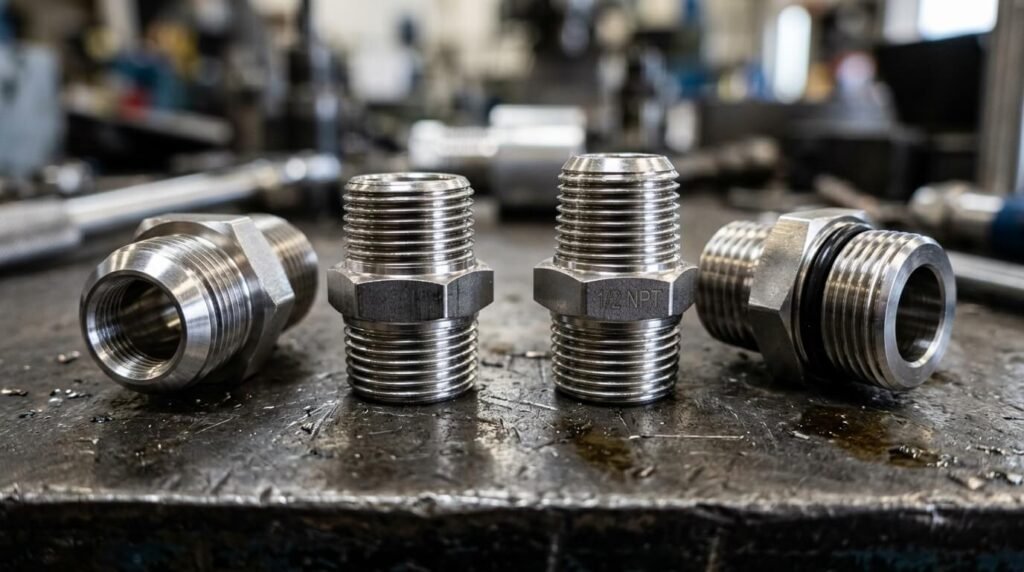
Material is only half the equation; the mechanical connection is equally important. When specifying stainless steel adapters, thread accuracy and surface finish are paramount to prevent galling (cold welding), a common issue with stainless steel threads.
- Stainless Steel JIC Fittings (SAE J514): Featuring a 37-degree flare seating surface, these are widely used in high-pressure applications. Quality machining on 316 stainless JIC fittings ensures reliable metal-to-metal sealing without leakage.
- BSP Fittings (BSPP & BSPT): Common in Europe and Asia. 304 and 316 BSP fittings are heavily utilized in marine equipment and heavy machinery.
- NPT Fittings: Used mostly in North America, these tapered threads require sealant. Stainless NPT fittings are excellent for general pipework and lower-pressure chemical lines.
- ORFS (O-Ring Face Seal): The gold standard for vibration resistance and eliminating leaks in high-pressure systems. Using 316 stainless steel for ORFS fittings provides the ultimate combination of corrosion resistance and zero-leak performance.
Why Material Traceability Matters in High-Pressure Systems
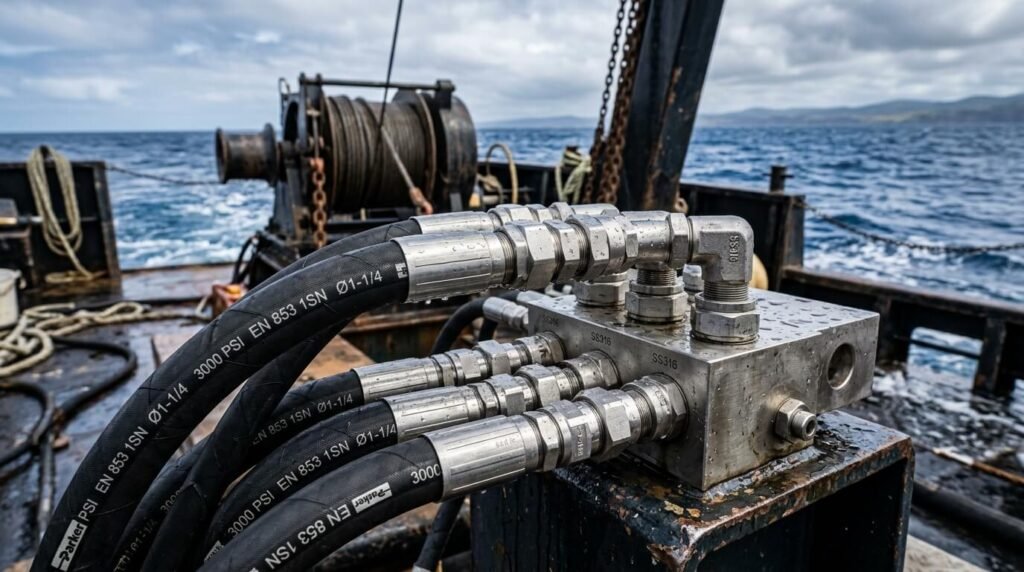
When a hydraulic system is operating at 3,000 PSI, 6,000 PSI, or higher, a fitting failure is not just an inconvenience—it is a critical safety hazard and an environmental liability. This is why material traceability is non-negotiable.
If an offshore rig requires 316 stainless steel hose fittings, but a supplier secretly substitutes 304 to cut costs, the fitting will corrode, weaken, and eventually rupture under pressure. At Kaitu Fitting, we ensure 100% material traceability. From our Swaged Hose Fittings to our precision Ferrules, we strictly test and verify our 304, 316, and 316L (low carbon for optimal weldability) raw materials.
At-a-Glance Comparison Table
| Feature | 304 Stainless Steel | 316 Stainless Steel |
|---|---|---|
| Molybdenum Content | 0% | 2.0% – 3.0% (Crucial for pitting resistance) |
| Chloride / Salt Resistance | Low to Moderate | Excellent (Marine Grade) |
| Primary Use Cases | Indoor hydraulics, fresh water, pneumatics | Offshore, marine, chemical processing, high-hygiene |
| Cost relative to Carbon Steel | Higher | Highest (Premium investment) |
Frequently Asked Questions (FAQ)
Can I mix 304 and 316 stainless steel hydraulic fittings in the same assembly?
In dry, indoor environments, mixing 304 and 316 stainless steel adapters is generally safe and will not cause immediate issues. However, in highly corrosive or wet environments (like marine applications), it is best practice to use 316 throughout the system. Mixing grades in an electrolyte-rich environment can sometimes lead to mild galvanic corrosion, though the risk is relatively low compared to mixing stainless with carbon steel.
Are 316 stainless steel JIC fittings stronger than 304?
No. From a mechanical perspective, the tensile strength and yield strength of 304 and 316 stainless steel are virtually identical (both typically have a tensile strength around 515 MPa). The difference lies entirely in their chemical composition and corrosion resistance, not their ability to handle physical pressure or torque.
What does the “L” mean in 316L stainless steel pipe fittings?
The “L” stands for “Low Carbon” (max 0.03% carbon content). 316L is used specifically for fittings that require heavy welding (like weld tube adapters). The low carbon content prevents carbide precipitation during the welding process, which protects the area around the weld from localized corrosion.
Conclusion
Selecting between 304 vs 316 stainless steel fittings dictates the longevity, safety, and maintenance schedule of your entire fluid control system. While carbon steel is great for standard environments, the leap to stainless is necessary for moisture and chemical resistance. Let the environment be your guide: choose 304 for cost-effective reliability in standard industrial settings, and specify 316 for uncompromised performance in offshore, marine, and chemical applications.
Whether you need standard BSP configurations, specialized ORFS adapters, or custom stainless steel hose fittings, contact Kaitu Fitting today. With decades of manufacturing expertise and ISO/IATF certifications, we deliver the precision and traceability your high-pressure systems demand.