
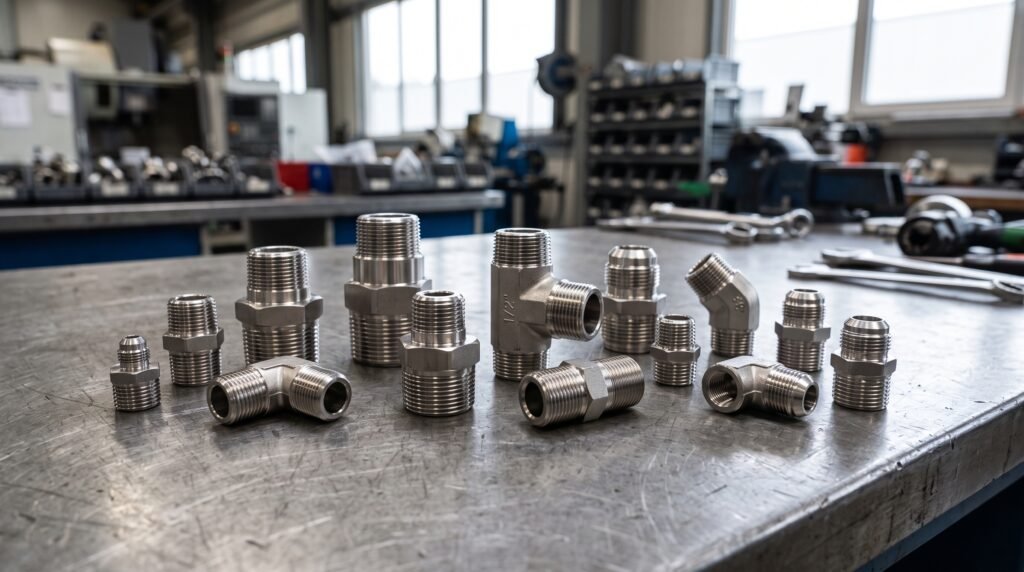
Why the wrong stainless steel adapter turns a small port into a system failure
For maintenance teams, OEM engineers, and distributors, stainless steel adapters are often selected under pressure: a machine is down, a prototype needs routing changes, or a customer requests a corrosion-resistant replacement. The part looks simple, but the wrong thread form, material grade, or sealing style can cause external leakage, thread galling, pressure loss, fluid contamination, or premature wear on the mating port.
A reliable hydraulic adapter must do more than join two ports. It has to match the thread standard exactly, handle working pressure and impulse spikes, resist the operating environment, and seal consistently through vibration and thermal cycling. In mobile equipment, chemical plants, food and beverage lines, offshore systems, and high-duty industrial hydraulics, adapter selection directly affects uptime and operator safety.
This guide explains how to evaluate stainless steel adapters from a practical purchasing and engineering perspective. It covers thread identification, 304 versus 316 material choices, sealing methods, pressure and temperature factors, installation practices, and supplier questions, so you can specify hydraulic connections with fewer surprises and fewer return shipments.
Where stainless steel hydraulic adapters deliver the most value
Stainless steel is typically chosen when plated carbon steel is not durable enough for the environment or process media. Common use cases include marine and offshore equipment, chemical processing, washdown areas, biopharmaceutical skids, food and beverage machinery, energy systems, and outdoor installations exposed to weather, road salts, or corrosive fluids. In these applications corrosion is not merely cosmetic; it pits sealing faces, seizes threads, and makes future disassembly difficult.
Adapters also solve layout and conversion problems. A circuit may require a straight, elbow, tee, cross, reducer, bulkhead, plug, or cap configuration. It may also need to connect a metric DIN port to a BSP hose end, a JIC tube line to an NPT component, or an ORFS assembly to a manifold face. In global supply chains, mixed thread standards are common, especially when pumps, valves, and hose assemblies are sourced from different regions.
When specifying adapters, review the available connection families rather than treating every part as a one-off purchase. A manufacturer’s hydraulic adapter range lets buyers compare thread types, body shapes, and sealing options before locking in drawings or maintenance stock lists, and it helps standardize repeat orders across a fleet.
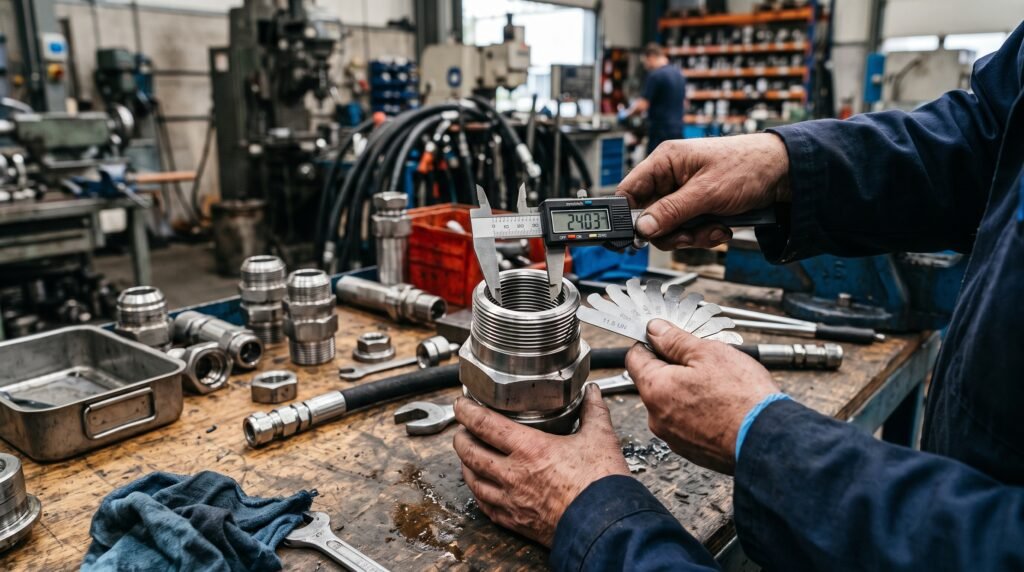
How to identify adapter thread types before ordering a replacement
Thread identification should begin with measurement, not visual guesswork. First determine whether the thread is parallel or tapered, then measure the outside diameter of a male thread or the inside diameter of a female thread, and confirm pitch with a thread gauge. Imperial threads express pitch as threads per inch; metric threads express pitch in millimeters between crests. A caliper, a pitch gauge, and a seat-angle gauge are the basic tools that prevent costly mismatches.
NPT threads are tapered and dominate North American fluid power. They seal by thread interference, normally with a compatible thread sealant. BSP threads come in parallel (BSPP) and tapered (BSPT) forms and are widely used in Europe and many international markets. BSPP usually seals with a bonded washer, an O-ring, or a 60-degree metal seat, while BSPT seals on the taper. Mixing BSP and NPT is a frequent and expensive error because some sizes look alike, yet their 55-degree versus 60-degree thread angles and pitches differ.
JIC connections use a 37-degree flare and are common across hydraulic tube and hose assemblies. ORFS connections use an O-ring face seal and are preferred where leak resistance is critical, especially in high-vibration circuits. Metric threads follow DIN or ISO styles and may seal with cutting rings, cone seats, bonded washers, or O-rings depending on the family. SAE straight-thread O-ring boss connections seal with an O-ring at the port spotface rather than on the threads themselves.
When matching a replacement from an existing machine, record both ends of the fitting separately. A male JIC x male NPT adapter is not interchangeable with a male SAE O-ring boss x male JIC adapter even when the overall shape looks similar. Photograph the part, measure both ends, and confirm each sealing surface so you do not order the correct thread on one side and the wrong connection on the other.
What 304, 316, and other stainless grades mean for hydraulic service
Material grade matters because stainless steels are not interchangeable. 304 stainless steel offers general corrosion resistance and suits many indoor or moderately corrosive environments. 316 stainless steel adds molybdenum, which sharply improves resistance to chlorides and many aggressive media. For marine exposure, chemical washdown, coastal equipment, and process systems, 316 stainless steel fittings are usually specified over 304 for longer service life.
Hydraulic adapters also need adequate mechanical strength, clean machinability, and compatibility with the mating component. Stainless steel is more prone to galling than carbon steel, particularly when stainless male and female threads are tightened together without lubrication or speed control. This is why surface finish, thread quality, and disciplined assembly practices matter as much as the alloy designation printed on the box.
Some applications add further constraints: low-temperature toughness, fluid compatibility, cleanability, or industry restrictions. A stainless adapter near food processing equipment may be chosen for smooth, cleanable surfaces and corrosion resistance, while one in offshore hydraulics is prioritized for chloride resistance and long maintenance intervals. If the application involves aggressive chemicals, confirm compatibility with both the stainless grade and the seal elastomer before committing to a design.
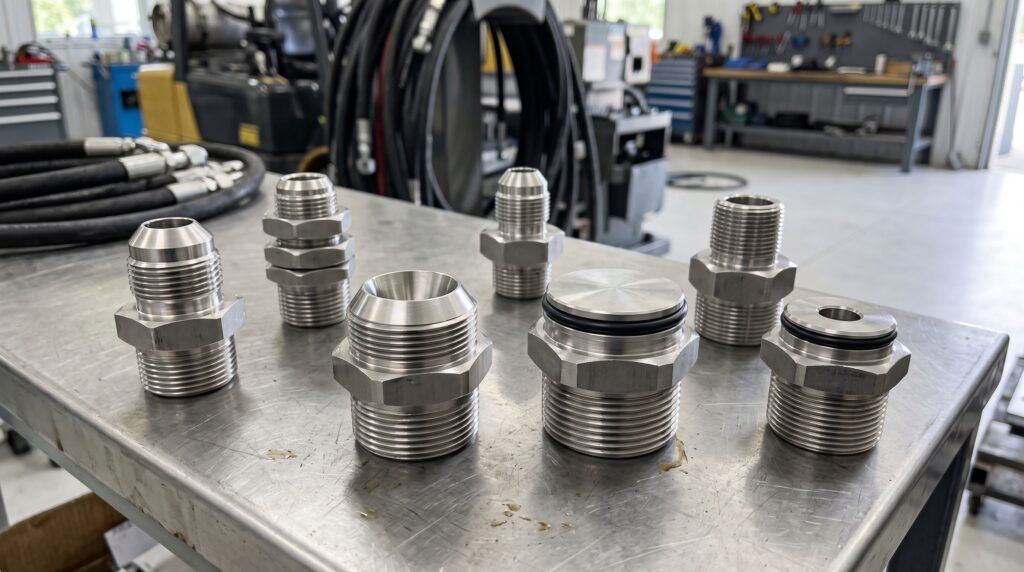
Why the sealing method matters as much as the thread itself
Threads create mechanical engagement, but the sealing method decides whether the connection stays leak-free. Tapered pipe threads such as NPT and BSPT seal through thread deformation plus sealant. They are common and convenient, but over-tightening can crack ports or distort the fitting, and reassembly grows less reliable once threads are damaged or contaminated with old sealant.
Flared connections, such as JIC 37-degree fittings, seal at the angled metal-to-metal interface. They are serviceable and practical for many hydraulic assemblies, yet sealing depends entirely on the condition of the flare seat and correct alignment. A scratched seat, a wrong flare angle, or a side-loaded hose can cause seepage even when the thread feels tight.
ORFS connections seal with an elastomeric O-ring compressed against a flat face, making them a strong choice for leak reduction in high-pressure, high-vibration systems. SAE O-ring boss ports also use an O-ring, but the seal sits at the port shoulder. Both designs reduce reliance on thread sealing and deliver excellent repeatability when the correct O-ring material, groove condition, and torque are used.
For OEM builds, the best sealing style depends on the equipment’s pressure, vibration, service access, and cleanliness requirements. For replacement work, the safest approach is usually to match the original sealing method unless there is an engineered reason to change. When upgrading a chronic leak, review the full assembly, including hose routing and mating-port condition, not the adapter alone.
Pressure ratings, temperature, and flow details buyers must verify
A stainless steel adapter should be rated for the system’s maximum working pressure, but buyers must also account for pressure spikes, impulse cycles, and temperature. Hydraulic circuits routinely see transient peaks above normal operating values. When an adapter sits near pumps, actuators, or fast-cycling valves, impulse and fatigue performance can matter more than the static pressure rating alone.
Adapter geometry affects flow and pressure drop. A compact elbow may solve a routing problem, but sharp direction changes raise turbulence. Reducers and conversion adapters should be chosen so the internal bore does not throttle flow or generate unnecessary heat. In critical, high-flow lines, compare actual bore size and body configuration rather than selecting on thread size alone.
Temperature drives both metal behavior and seal performance. Stainless steel tolerates a broad temperature range, but O-rings, bonded seals, and thread sealants each have narrower limits. A seal that performs well in mineral hydraulic oil at room temperature may fail in high-temperature service, water-glycol fluids, phosphate-ester synthetics, or hot cleaning chemicals.
Before placing large orders, verify the applicable standard, material, pressure class, and inspection expectations. For projects needing multiple components, reviewing the broader Product lineup helps standardize adapter, hose fitting, ferrule, and assembly choices across a single equipment platform.
Installation practices that protect stainless adapters from leaks and galling
Even a correctly specified adapter fails early if installed poorly. Confirm that threads and sealing faces are clean, undamaged, and free of metal chips or hardened sealant. For O-ring styles, inspect the O-ring for cuts, flat spots, swelling, or hardening, and replace any questionable seal rather than compensating with extra torque.
Stainless threaded connections demand care to prevent galling, where mating surfaces seize during tightening and damage the threads beyond reuse. A compatible lubricant or approved anti-seize compound may help, but it must suit the fluid, environment, and sealing method. Apply thread sealant only where the design calls for it, never on flare seats or O-ring sealing faces.
Use controlled tightening whenever possible. Torque values vary by thread type, material, size, seal design, and manufacturer guidance, so do not rely on feel alone. Over-tightening crushes O-rings, distorts flare seats, splits ports, and shortens fatigue life; under-tightening permits movement, leakage, and thread wear. For hose assemblies, support the hose during tightening to prevent twist, which shortens hose life and side-loads the adapter.
When stainless adapters connect to swaged hose fittings or other hose ends, evaluate the complete assembly together. Adapter orientation, bend radius, hose length, and clamp placement all influence vibration resistance and overall service life.
A practical purchasing checklist for OEMs, distributors, and maintenance teams
Before ordering stainless steel adapters, define both ends of the connection: thread standard, size, gender, sealing method, and configuration. Then specify material grade, pressure requirement, temperature range, fluid type, and environmental exposure. For recurring builds, add drawing numbers, approved alternatives, packaging expectations, and inspection criteria to keep orders consistent over time.
For distributors and maintenance teams, stocking strategy should follow the actual equipment population. Identify the machines and thread standards seen most often, then build inventory around high-turn items such as common JIC, BSP, NPT, ORFS, and metric conversions. Avoid overstocking visually similar adapters without clear labeling, since mixed standards lead to installation mistakes during urgent repairs.
For OEMs, standardization reduces assembly time and procurement complexity. Where practical, limit the number of thread families on a machine platform and choose sealing styles that match the system’s leak-risk profile. If a design requires custom geometry, a special alloy, or a conversion not available off the shelf, share drawings and performance targets with the supplier early.
Supplier capability is decisive when adapters serve demanding hydraulic systems. Look for consistent machining quality, standard compliance, material traceability when required, testing capability, and responsive engineering support. If your project involves custom hydraulic solutions or a cross-reference from an existing part, share specifications through the Contact page to confirm the most suitable adapter path.
FAQ
Are stainless steel adapters better than carbon steel adapters?
They are better for corrosive, washdown, marine, chemical, and hygienic environments. Plated carbon steel may still suit many general hydraulic systems where corrosion exposure is limited and cost is a priority.
Can NPT and BSP threads be connected if they look similar?
No. NPT uses a 60-degree thread angle and BSP uses 55 degrees, and their pitches differ in many sizes. Forcing them together damages threads and causes leaks.
When should I choose 316 stainless steel adapters?
Choose 316 stainless steel for chloride exposure, marine and offshore environments, chemical processing, and any application where its molybdenum content provides needed corrosion resistance over 304.
Do stainless steel adapters always need thread sealant?
No. Tapered pipe threads such as NPT and BSPT usually need a compatible sealant, but JIC, ORFS, SAE O-ring boss, and many metric designs seal at a flare, flat face, bonded washer, or O-ring instead.
What information should I provide when requesting a stainless hydraulic adapter?
Provide thread type and size for both ends, gender, body shape, sealing method, material grade, pressure requirement, fluid, temperature range, and any standard or drawing reference.