
Import and procurement directors frequently encounter the term MIP fitting in RFQs, technical drawings, and supplier quotations. However, terminology inconsistency across global regions—from North America to Asia and the Middle East—creates significant specification ambiguity.
Many suppliers use “MIP” loosely without clarifying the underlying thread standards, pressure classes, or sealing methods. This lack of precision is not just a clerical nuance; it is a technical risk.
The High Cost of Specification Ambiguity
Incorrectly identifying a thread specification during the procurement phase leads to a cascade of operational failures:
- Shipment Rejection: Custom clearance issues or quality control (QC) failures upon arrival.
- Warehouse Dead Stock: Thousands of units that cannot be integrated into local systems.
- Field Leakage: Potential warranty claims and catastrophic failures in pressurized systems.
- Contractual Liability: Legal exposure with downstream distributors when products fail to meet regional building or industrial codes.
Furthermore, the misalignment between plumbing-grade and hydraulic-grade fittings increases performance risks. Without documented QC verification, your procurement team remains exposed to audit and compliance vulnerabilities.
This guide provides the technical breakdown you need to understand what is an MIP fitting, how it differs from similar threads, and the verification steps you must implement before approving bulk orders.
1. What Exactly Is an MIP Fitting? (Technical Definition & Standards)
Terminology Clarification
In the industrial hardware sector, MIP stands for Male Iron Pipe. Despite the “iron” in the name, the term is now used universally for fittings made from brass, carbon steel, and—most critically for high-performance systems—stainless steel.
An MIP fitting typically refers to external tapered pipe threads. In the North American market, this is most commonly aligned with the NPT (National Pipe Tapered) thread standard, governed by ANSI/ASME B1.20.1.
Structural Characteristics
- Tapered Profile: These fittings feature a 1° 47′ taper angle. As the male fitting is threaded into a female port, the diameters of the threads increase, creating a mechanical seal.
- Interference Seal: The seal is achieved via thread deformation. The “wedging” action prevents media from escaping.
- Sealant Requirements: Because of the nature of the crest-to-root contact, MIP fittings require thread sealant, such as PTFE tape or specialized anaerobic sealants, to fill the microscopic gaps and prevent leaks.
Typical Applications
You will find MIP fittings in plumbing systems, low-to-medium pressure industrial fluid lines, and specific hydraulic applications—provided they are manufactured to the correct pressure rating.
Key Procurement Insight: “MIP” is a commercial naming convention, not an independent technical standard. As a decision-maker, you must force your suppliers to confirm the actual underlying standard (NPT vs. NPTF vs. BSPT) before signing a Purchase Order.
2. MIP vs. NPT vs. BSPT — Why Thread Identification Impacts Import Risk
The global market is flooded with various thread types that look identical to the naked eye but are functionally incompatible.
NPT (United States Standard)
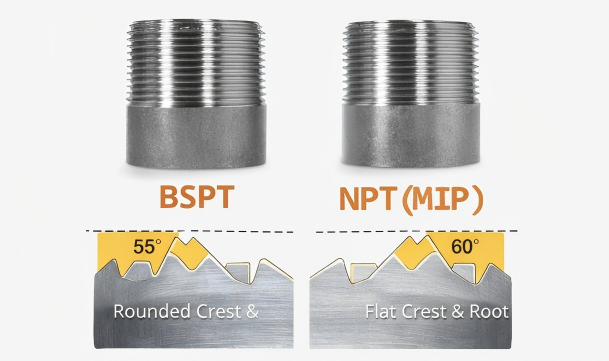
The most common “MIP” specification. It features a 60° thread angle and a tapered profile. It relies on interference sealing but allows for a small clearance between the thread crests and roots.
BSPT (British Standard Pipe Tapered)
Common in Europe, Asia, and the Commonwealth. While it is also tapered, it features a 55° thread angle and a different pitch (threads per inch). BSPT is not interchangeable with NPT/MIP. Forcing an MIP fitting into a BSPT port will result in thread stripping and high-pressure leaks.
NPTF (Dryseal Variant)
This is the “heavy-duty” cousin of the standard MIP/NPT fitting. It is designed for metal-to-metal sealing without the need for sealant. In hydraulic pressure systems, NPTF offers higher reliability.
| Feature | MIP (NPT) | BSPT | NPTF |
| Thread Angle | 60° | 55° | 60° |
| Taper | 1:16 | 1:16 | 1:16 |
| Seal Type | Sealant Required | Sealant Required | Metal-to-Metal |
Actionable Procurement Controls
To mitigate commercial risk, we recommend the following:
- Require Thread Confirmation: Your PO documentation should explicitly state “ANSI/ASME B1.20.1” rather than just “MIP.”
- Request Gauge Inspection Reports: Ensure the supplier is using calibrated L1 and L6 thread gauges.
- Destination Logic: Cross-check the market destination. If you are importing for a Middle Eastern project, verify if the system is based on British (BSPT) or American (MIP/NPT) standards.
[Insert Case Study: Impact of thread mismatch on a 50,000-unit industrial valve project].
3. Is MIP Suitable for Stainless Steel Hydraulic Systems?
When sourcing for stainless steel systems, the stakes are higher due to material properties.
Pressure and Material Factors
- Thread Engagement: Stainless steel is harder than brass or carbon steel. Proper engagement depth is critical to ensure the tapered threads lock correctly.
- Galling Risk: Stainless steel threads are prone to “galling” (cold welding) during installation. We recommend specifying high-quality surface finishes and ensuring installers use anti-seize lubricants.
- Corrosion Resistance: For import, specify Grade 316 stainless steel over 304 for any marine or chemical processing applications to ensure longevity. [Insert Data: Corrosion rates of 304 vs 316 in saline environments].
When MIP May Not Be Ideal
MIP fittings are highly versatile, but they are not universal solutions. They should be avoided or scrutinized in:
- High-Vibration Systems: Constant vibration can loosen tapered thread seals over time.
- Ultra-High-Pressure Applications: Standard plumbing-grade MIP fittings may fail; hydraulic-grade alternatives with documented wall thickness are required.
- Zero-Leakage Environments: In these cases, NPTF or SAE O-ring boss fittings are preferred.
Procurement Decision Matrix
Before approving a bulk stainless steel order, validate:
- Hydrostatic Test Reports: Did the batch hold 1.5x the rated pressure?
- MTC (Mill Test Certificate): Does the chemical composition match ASTM standards?
- Traceability: Can the supplier trace the batch back to the raw material heat number?
4. Common Mistakes to Avoid When Sourcing MIP Fittings
Avoid these five pitfalls to protect your bottom line:
- Assuming “MIP” Equals NPT Without Verification: Never leave the thread standard to the supplier’s “best guess.” Explicitly define the standard in the contract.
- Ignoring Pressure Rating Documentation: Do not accept verbal assurances. Request certified testing data for the specific SKU.
- Overlooking Thread Quality: Poorly machined threads lead to “burrs” and inconsistent tapers. Require validation against ANSI/ASME tolerances.
- Mixing Grades: Ensure the manufacturing process (casting vs. CNC machining) matches the application. A plumbing-grade casting will fail in a hydraulic-grade environment.
- Choosing Based Solely on Unit Price: A $0.50 savings per unit disappears instantly when you factor in a 5% failure rate and the cost of international returns. Focus on the Total Landed Cost, including the cost of potential downtime and brand damage.
Protecting Your Procurement Decisions Starts with Specification Clarity
An MIP fitting is essentially a commercial shorthand, not a comprehensive technical definition. For import directors, success lies in the details. Thread verification, pressure validation, and material traceability are non-negotiable requirements that protect your company from compliance risks and strengthen your downstream distributor relationships.
At our facility, we bridge the gap between commercial terminology and engineering precision. We ensure every fitting labeled as “MIP” meets the rigorous standards required for international industrial use.
Call-to-Action (CTA)
Before committing to your next bulk purchase:
- Book a stainless steel MIP sample for technical verification in your own lab.
- Evaluate our documented QC process, including our gauge calibration logs.
- Validate thread precision and pressure performance firsthand to ensure it meets your specific regional requirements.
👉 Contact our team today to request your sample kit and reduce your next import risk.