
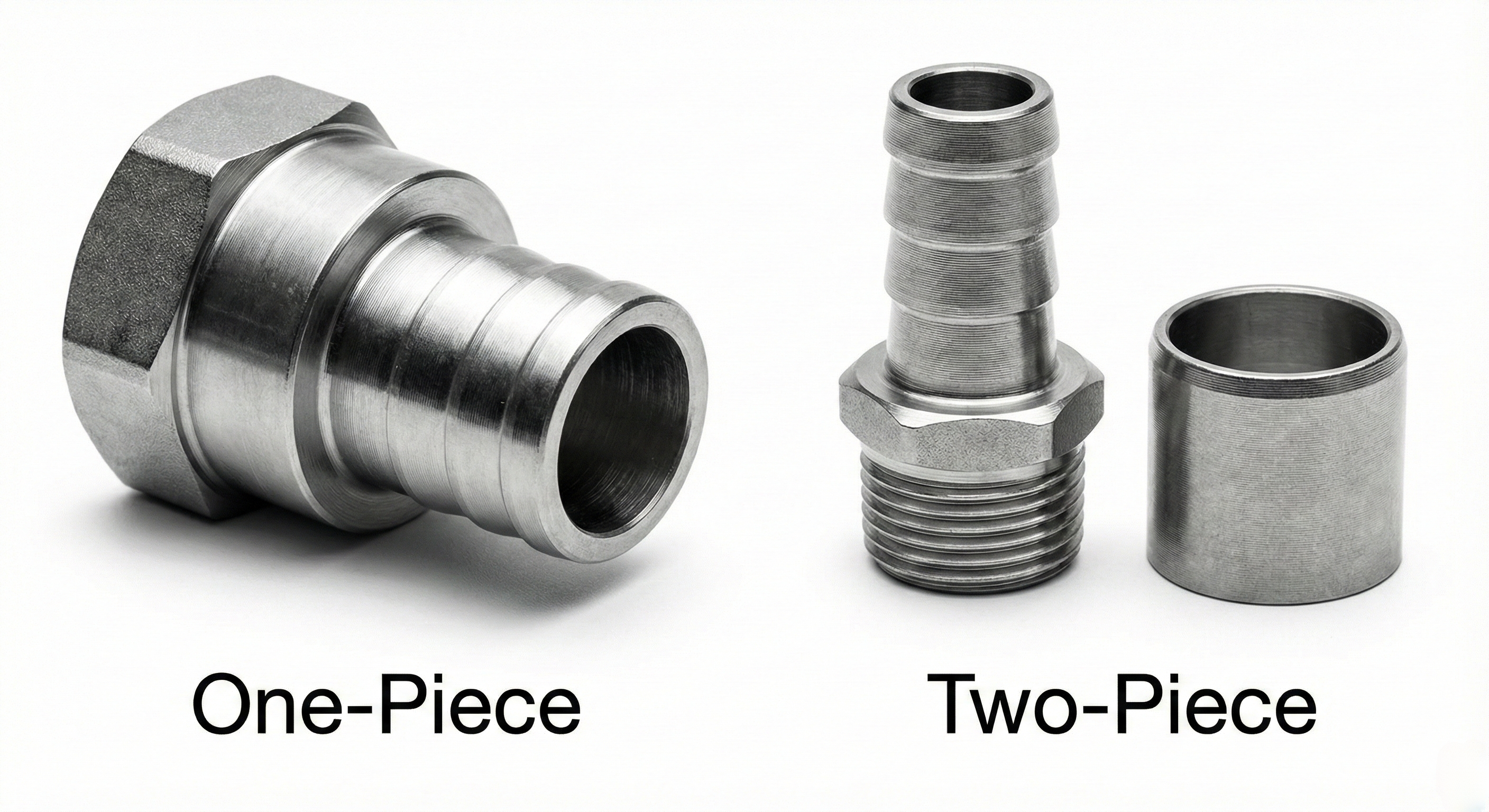
TL;DR: One-piece hydraulic fittings (integrated ferrule) generally offer higher durability, consistent crimping, and lower leak risks, making them ideal for OEM and high-vibration applications. Two-piece fittings (separate ferrule and insert) provide lower upfront costs and greater inventory flexibility for maintenance and repair (MRO) scenarios. The right choice depends on your priority: long-term reliability vs. inventory versatility.
One-Piece vs. Two-Piece Hydraulic Fittings: What’s the Real Difference?
Conclusion: The core difference lies not in their function—both transport fluid—but in their structural design affecting reliability and assembly consistency.
What Is a One-Piece Hydraulic Fitting?
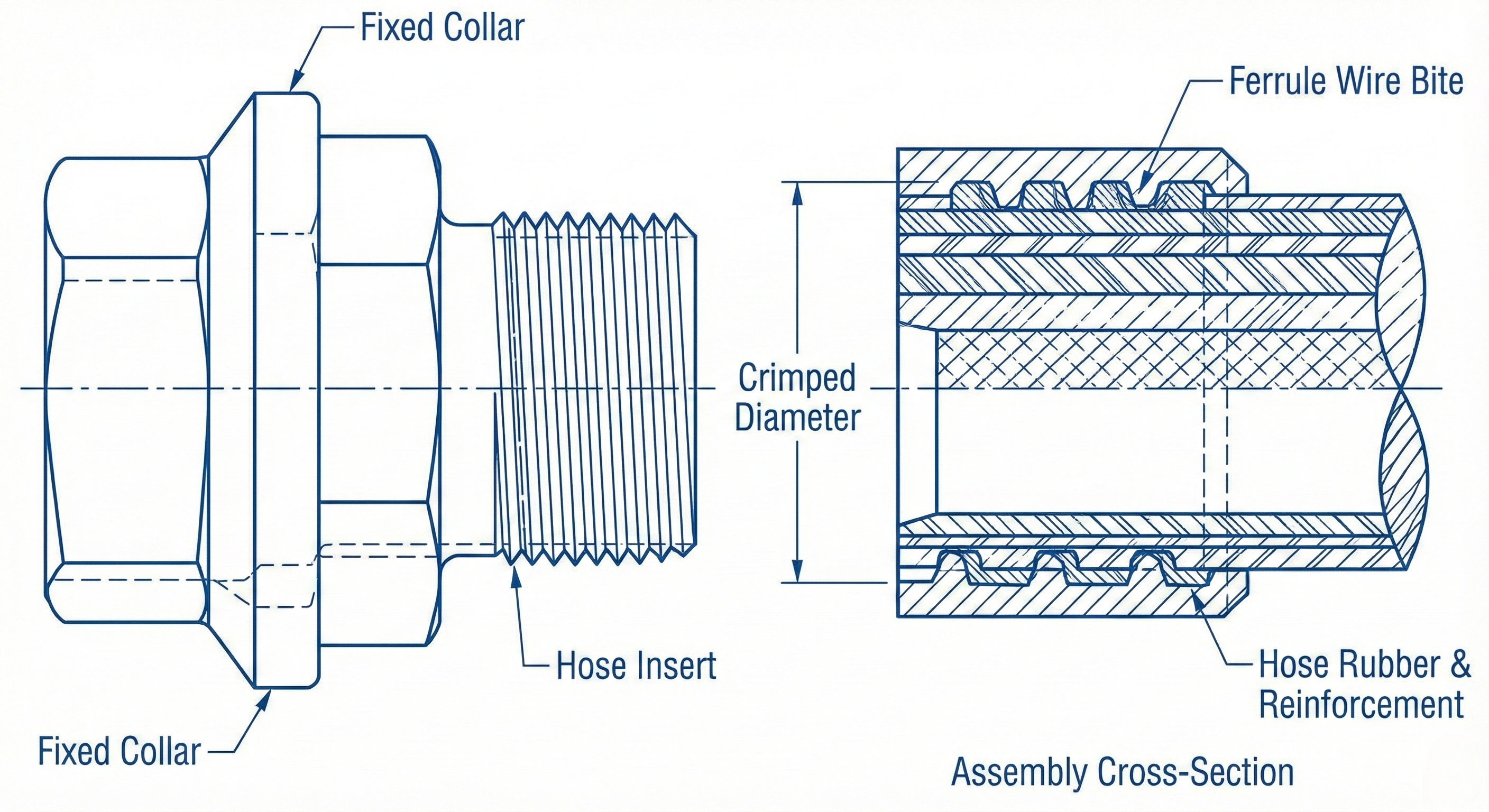
In a one-piece fitting, the ferrule (the crimping shell) is permanently pre-crimped onto the fitting body at the factory.
- Consistency: This eliminates the variable of “ferrule alignment” during hose assembly.
- Application: They are the standard for most modern OEM production lines due to their “foolproof” assembly nature.
What Is a Two-Piece Hydraulic Fitting?
A two-piece fitting consists of two separate inventory items: the hose insert (nipple) and the ferrule.
- Flexibility: You can mix and match ferrules for different hose types (e.g., 1SN vs. 2SN) with the same insert.
- Application: Widely used in repair shops and general maintenance where stocking flexibility is critical.
| Feature | One-Piece Fitting | Two-Piece Fitting |
|---|---|---|
| Structure | Ferrule pre-attached to body | Separate ferrule and insert |
| Assembly Risk | Low (Self-aligning) | Moderate (Requires alignment) |
| Inventory SKUs | High (Specific to hose type) | Low (Mix & Match) |
Cost Comparison: Initial Price vs. Long-Term Cost
Conclusion: While two-piece fittings often have a lower “sticker price,” one-piece fittings can be cheaper when factoring in assembly labor and failure risks.
Initial Manufacturing and Purchase Cost
Two-piece systems allow manufacturers to mass-produce ferrules and inserts separately, often resulting in a lower per-unit purchase cost for bulk buyers. One-piece fittings involve an extra manufacturing step (pre-crimping the shell), which adds slightly to the initial unit price.
Hidden Costs in Assembly and Rework
The true cost of a fitting includes the labor to assemble it and the risk of failure.
- Labor Efficiency: One-piece fittings slide directly onto the hose. Two-piece fittings require the operator to select the ferrule, place it on the hose, insert the fitting, and ensure proper depth—taking 20-30% more time per hose assembly.
- Rework Risk: Misalignment of a two-piece ferrule is a common cause of “collar slide-off” or leakage, leading to expensive warranty claims.
| Cost Factor | One-Piece Economy | Two-Piece Economy |
|---|---|---|
| Purchase Price | $$ (Slightly Higher) | $ (Lower) |
| Assembly Labor | Fast | Slower |
| Inventory Management | Simple (1 SKU) | Complex (Match insert + ferrule) |
Durability and Reliability in Real Applications
Conclusion: In high-pressure, high-vibration, or high-cycle applications, one-piece fittings offer superior stability.
Fatigue Resistance and Leak Risk
Because the ferrule is mechanically staked to the fitting body in a one-piece design, there is zero chance of the ferrule sliding down the hose during the crimping cycle. This ensures the “bite” into the hose reinforcement is always in the engineered position, significantly reducing the risk of hose blow-off.
Performance in High-Pressure and Vibration Systems
For excavators or mining equipment operating at 5000+ PSI with constant vibration, misalignment in a two-piece fitting can lead to stress concentration. One-piece fittings maintain structural integrity better under these dynamic loads.
Explore our high-pressure options: One-Piece Fittings Catalog vs. Ferrules for Two-Piece Systems.
Which One Should You Choose?
Conclusion: The choice isn’t about which is “better,” but which fits your operational model.
When One-Piece Fittings Make More Sense
- OEM Production: Consistency is key. You cannot afford a 1% error rate on an assembly line.
- High-Pressure Applications: Safety is paramount.
- Field Repair Speed: When a hose blows on a site, sliding on a single piece is faster than fumbling for matching parts.
When Two-Piece Fittings Are the Better Option
- Maintenance Shops (MRO): You need to service a wide variety of old hoses. Stocking ferrules and inserts separately allows you to adapt to non-standard hose wall thicknesses.
- Cost-Sensitive Bulk Projects: Where assembly labor is cheap, and material cost is the primary driver.
- Low-Pressure Lines: Return lines or suction lines where the added security of one-piece is overkill.
For a detailed inventory strategy, consult our Buying Guides.
FAQ: One-Piece vs Two-Piece Hydraulic Fittings
Are one-piece hydraulic fittings more durable?
Generally, yes. Their integrated construction eliminates the risk of ferrule misalignment during crimping, ensuring a consistent and reliable grip on the hose reinforcement, which is critical for high-pressure durability.
Are two-piece fittings less reliable?
Not inherently. A correctly assembled two-piece fitting is just as reliable as a one-piece fitting. However, the process of assembling them introduces more human error variables, making them statistically less consistent in large-scale production.
Why do OEMs prefer one-piece fittings?
Consistency and Liability. OEMs prefer one-piece fittings because they standardize the crimping process, reduce assembly time, and significantly lower the warranty risks associated with hose assembly failures.
Can two-piece fittings be used in high-pressure systems?
Yes. As long as the correct ferrule (e.g., skive vs. non-skive) is matched with the correct insert and hose, two-piece fittings can handle extreme pressures (up to 6000 PSI). Strict adherence to crimping charts is mandatory.