
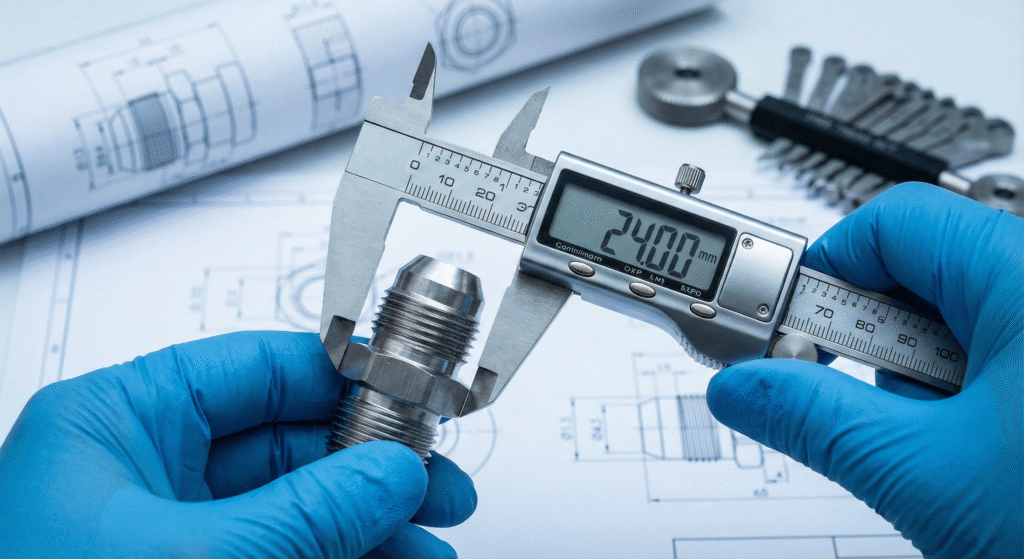
TL;DR: Importing hydraulic adapters from China involves hidden quality risks such as material substitution, thread mismatch, and unstable machining tolerances. A structured QC checklist—from supplier audits to pre-shipment inspections—helps catch these issues before shipment, reducing rework, warranty claims, and field failures.
Understanding Hydraulic Adapters and Import Risks
What are hydraulic adapters and their common applications?
Hydraulic adapters are critical components used to connect hoses, pipes, and tubes of different standards (e.g., JIC to NPT) or sizes within a fluid power system. They are the backbone of industries ranging from construction machinery and agriculture to high-precision industrial automation. However, tolerance requirements vary drastically; a fitting suitable for an agricultural tractor may fail in a high-pressure injection molding machine.
Common quality risks when importing from China
While China offers competitive manufacturing, buyers must be vigilant against specific quality issues. The most common risks include material grade substitution (e.g., using 304 instead of 316L stainless steel), mixed thread standards (confusing BSPP with BSPT), and inconsistent surface plating. Often, these defects are invisible to the naked eye and only manifest as leaks or bursts under high-pressure operating conditions.
Supplier Evaluation Before Ordering
How to audit a hydraulic adapter supplier in China?
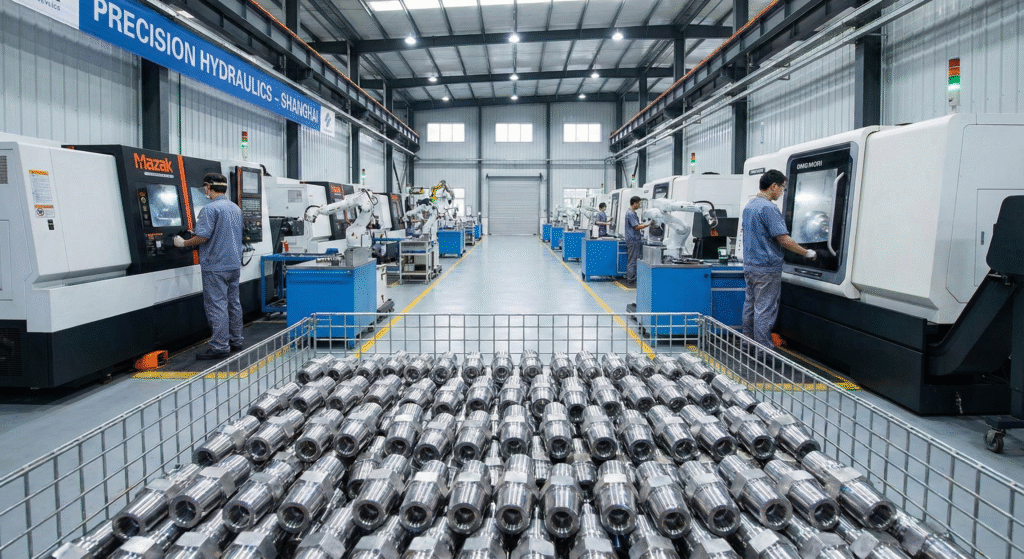
Before placing a PO, you must verify if the supplier is a genuine manufacturer or a trading company. Focus your audit on their production capabilities: Do they operate modern CNC machines? Do they have in-house testing facilities (salt spray, impulse testing)? Crucially, assess their familiarity with international standards like SAE J514, ISO 8434, and DIN 2353. A supplier who cannot clearly explain the difference between these standards is a major red flag.
Learn more about our manufacturing capabilities at Kaitu Factory Profile.
Which certifications and documents should be verified?
Certificates are essential, but they must be validated against actual products. Request Mill Test Reports (MTRs) for raw materials, dimensional drawings for critical parts, and pressure rating declarations. Do not rely on generic ISO 9001 certificates alone; ask for specific product-level documentation.
| Document Type | What to Verify | Red Flag |
|---|---|---|
| Mill Test Report (MTR) | Chemical composition (e.g., Mo > 2% for SS316) | Generic report with no heat number |
| Dimensional Drawing | Tolerances on sealing seats (37° or 60° cones) | “Standard” dimensions without tolerance limits |
| Salt Spray Report | Hours to red rust (e.g., >72h for Zinc Plated) | Outdated dates or copy-pasted data |
Material and Dimensional Quality Control Checklist
How to verify material grade and heat treatment?
Material composition is the most critical factor for corrosion resistance and pressure holding. Use a handheld XRF spectrometer to verify material grades (Carbon Steel, SS304, SS316L) upon receipt of samples. Additionally, verify heat treatment processes if you are buying components like ferrules, which require specific hardness to bite into the hose correctly.
How to inspect threads, tolerances, and sealing surfaces?
Visual inspection is not enough. You must use calibrated Go/No-Go thread gauges to verify compliance with standards like SAE J514. Inspect sealing surfaces (cones and flares) under magnification for chatter marks, scratches, or burrs. Even a microscopic scratch on a metal-to-metal seal will cause leakage.
| Inspection Point | Tool / Method | Acceptance Criteria |
|---|---|---|
| Thread Accuracy | Go/No-Go Gauges | Go enters fully; No-Go stops < 2 turns |
| Sealing Surface | Visual / Profilometer | Ra 0.8 to 1.6, no visible scratches |
| Across Flats (Hex) | Calipers | ISO/SAE specified tolerance |
In-Process and Pre-Shipment Inspection
When is third-party inspection necessary?
For high-value orders or when working with a new supplier, investing in a third-party inspection (e.g., SGS, Intertek, or a dedicated QC agency) is highly recommended. Ensure the inspection protocol clearly defines the AQL (Acceptable Quality Limit) sampling plan and specific testing methods for hydraulic fittings.
What should be checked before shipment?
Do not overlook packaging. Hydraulic fittings are heavy and prone to thread damage during transit. Verify that threads are protected with plastic caps and that boxes are reinforced. Check labeling to ensure part numbers, PO numbers, and descriptions match exactly to avoid customs delays or warehouse confusion.
Decision Guide: Reducing Import Risk
How a QC checklist supports purchasing decisions
Conclusion: Implementing a structured QC checklist moves the risk management process upstream to the ordering and production phases. Detection at the factory floor is infinitely cheaper than managing a warranty claim after the parts have been installed on a machine in another continent.
Balancing cost savings and quality assurance
The lowest price on the quote sheet is rarely the lowest total cost. “Cheap” fittings often suffer from poor plating (rusting in weeks) or thread defects (slowing down assembly lines). Stable quality is the true long-term cost advantage. Always budget for QC activities as part of your landed cost.
FAQ
What is the most critical quality check for hydraulic adapters?
Thread verification and sealing surface integrity. While material grade is important for long-term durability, a thread defect or a scratched seat causes immediate failure (leakage) upon installation.
Can Chinese hydraulic adapters meet SAE or ISO standards?
Yes, absolutely. Many top-tier Chinese manufacturers, including Kaitu, produce fittings that strictly adhere to SAE and ISO standards. The key is to specify the standard clearly in your contract and verify it with a QC checklist.
How often should suppliers be re-audited?
Annually. Even trusted suppliers can experience staff turnover or equipment degradation. A yearly audit ensures that their quality management system (ISO 9001) remains active and effective.
Ready to secure your supply chain? Contact Kaitu Fitting today to discuss our quality assurance protocols and request a sample kit.