
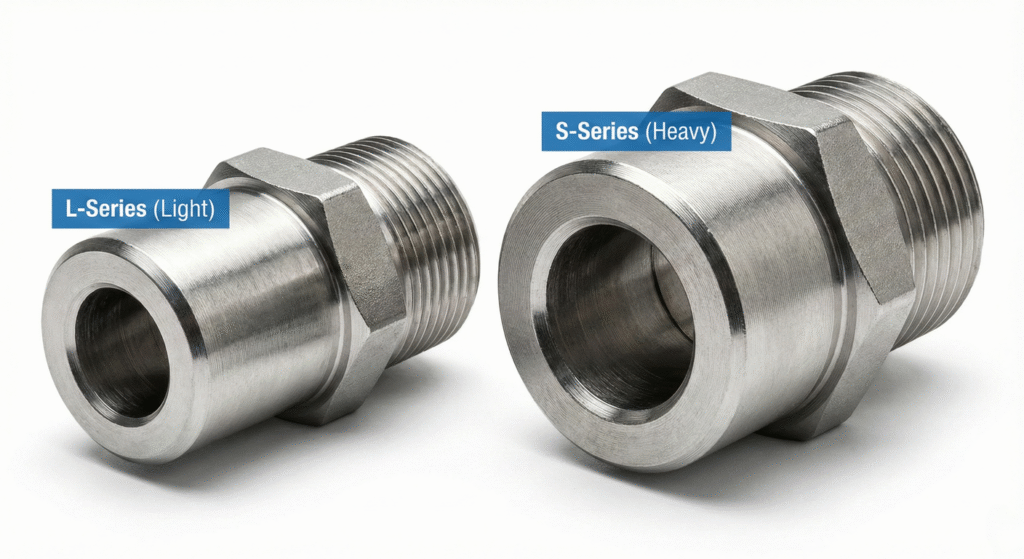
TL;DR: DIN 2353 compression fittings are divided into L-Series (Light) and S-Series (Heavy). While they may share the same Tube Outer Diameter (OD), they differ significantly in wall thickness, thread size, and pressure rating. They are not interchangeable. L-Series is for medium-pressure lines, while S-Series handles high-pressure, high-vibration, and water-hammer conditions.
Understanding DIN 2353 Compression Fittings
What Is DIN 2353?
Point: DIN 2353 is the prevalent German standard (often harmonized with ISO 8434-1) defining 24° cone compression fittings using a cutting ring (ferrule). It specifies the critical dimensions, tolerances, and material requirements to ensure a leak-free metal-to-metal seal.
For a broader look at identification, see our Guide to Identifying Hydraulic Fittings.
Common Applications of DIN 2353 Fittings
Point: These fittings are the industry standard for metric hydraulic systems in Europe and Asia. You will find them on:
- Mobile construction equipment (Excavators, Loaders)
- Industrial injection molding machines
- Marine fluid power systems
- Agricultural machinery
DIN 2353 L-Series Explained (Light Series)
L-Series Dimensions and Design Features
Point: The “L” stands for “Leicht” (Light). These fittings feature thinner tube walls, smaller nuts, and a compact design. They are engineered to optimize space and weight without sacrificing performance in standard applications.
Typical Pressure Ratings and Use Cases
Note: L-Series is the go-to choice for general industrial hydraulics (typically up to 315 Bar for smaller sizes). It balances cost and performance effectively.
| Tube OD (mm) | Thread Size (Metric) | Max Working Pressure (PB) |
|---|---|---|
| 6L | M12 x 1.5 | 315 Bar |
| 10L | M16 x 1.5 | 315 Bar |
| 15L | M22 x 1.5 | 315 Bar |
| 22L | M30 x 2.0 | 160 Bar |
DIN 2353 S-Series Explained (Heavy Series)
S-Series Dimensions and Structural Differences
Point: The “S” stands for “Schwer” (Heavy). These fittings are robust, featuring thicker walls and larger, heavier nuts for the same tube OD. The “Heavy” designation refers to their ability to withstand severe mechanical stress.
High-Pressure Applications and Safety Margin
Conclusion: S-Series provides a critical safety margin for systems prone to pressure spikes (water hammer) or extreme vibration. They are mandatory for heavy-duty earthmoving and mining applications.
| Tube OD (mm) | Thread Size (Metric) | Max Working Pressure (PB) |
|---|---|---|
| 6S | M14 x 1.5 | 630 Bar |
| 10S | M18 x 1.5 | 630 Bar |
| 16S | M24 x 1.5 | 400 Bar |
| 20S | M30 x 2.0 | 400 Bar |
L-Series vs. S-Series: Key Dimensional Differences
Tube Outer Diameter vs. Wall Thickness
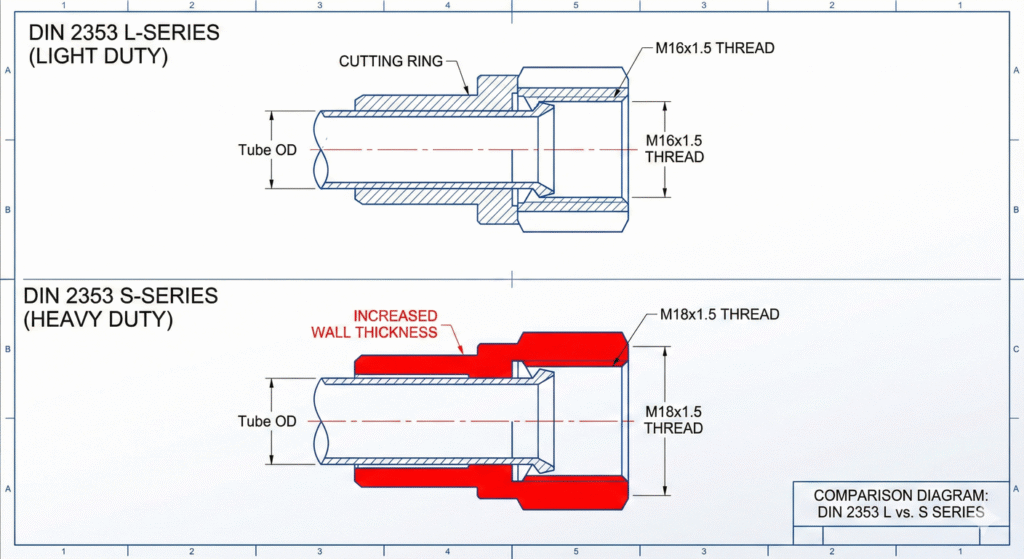
Note: This is the most common confusion point. A 10mm tube can use either a 10L or a 10S fitting. However, because the S-Series is designed for higher pressure, the fitting body is bulkier, and the thread size is different to accommodate the stress.
Pressure Rating and Mechanical Strength
Point: S-Series fittings support significantly higher working pressures (up to 630 Bar) compared to L-Series of the same tube size. This 2x pressure capability is why they cannot be swapped.
| Feature | L-Series (Light) | S-Series (Heavy) |
|---|---|---|
| Example Size | 10L (10mm Tube) | 10S (10mm Tube) |
| Thread | M16 x 1.5 | M18 x 1.5 |
| Max Pressure (Steel) | 315 Bar | 630 Bar |
| Best For | General Hydraulics | High Pressure / Vibration |
How to Choose Between L-Series and S-Series
Selection Based on System Pressure
Conclusion: Always select the series based on the maximum dynamic system pressure, not just the tube size. If your system peaks at 400 Bar, L-Series (rated for 315 Bar) is unsafe; you must use S-Series.
Industry Standards and Regional Preferences
Point: European OEMs often specify DIN 2353 explicitly on drawings. When exporting or replacing parts, cross-verify the thread dimension with calipers to confirm the series.
Need help with other standards? Check our Hydraulic Fitting Selection Guide.
Common Mistakes and Compatibility Warnings
Are L-Series and S-Series Interchangeable?
Conclusion: No. Even if the Tube OD is the same, the thread sizes usually differ (e.g., M16 vs M18 for 10mm tube). Attempting to force an L-Series nut onto an S-Series body will strip the threads and cause catastrophic failure.
Installation and Assembly Errors to Avoid
Note: A common error is using an L-Series cutting ring (ferrule) with an S-Series nut. While they might look similar, the dimensional tolerances are different, leading to a weak “bite” on the tube and eventual blowout.
FAQ
Can I use the same tube with both L and S series fittings?
Technically yes, but practically no. While a 10mm OD tube fits into both, the S-Series fitting is designed for heavy-wall tubing to handle high pressure. Using thin-wall tubing with S-Series fittings may cause the tube to collapse during crimping.
How do I identify whether a fitting is L-Series or S-Series?
Check the markings and measure the thread. Most reputable manufacturers, including Kaitu, stamp “L” or “S” along with the size (e.g., “10L” or “10S”) on the nut. If unmarked, measure the thread OD: M16 indicates 10L, while M18 indicates 10S.
Is DIN 2353 still valid compared to ISO 8434?
Yes. DIN 2353 is the original German standard, while ISO 8434-1 is the international standard that incorporated it. They are dimensionally identical for the 24° cone connection, and the terms are often used interchangeably in the industry.
Unsure which series fits your application? Contact Kaitu Technical Support for expert advice on DIN 2353 selection.