
TL;DR: 316L stainless steel offers superior corrosion resistance, chemical compatibility, and durability compared to 304 stainless steel, primarily due to the addition of Molybdenum. For hydraulic systems exposed to harsh chemicals, marine environments (saltwater), or high-pressure conditions, 316L is the mandatory choice to prevent pitting and failure, despite its slightly higher initial cost.
Understanding 316L and 304 Stainless Steel
Composition and Material Properties
Key Point: The defining difference lies in the chemistry. While both are austenitic stainless steels, 316L contains 2-3% Molybdenum, an element absent in 304. Additionally, the “L” in 316L stands for “Low Carbon” (max 0.03%), which minimizes carbide precipitation during welding and improves intergranular corrosion resistance.
Typical Applications
Conclusion: 304 stainless steel is the standard “18/8” alloy used for general indoor hydraulic lines and standard industrial machinery where corrosion risk is low. 316L stainless steel is the industry standard for marine fittings, offshore oil platforms, pharmaceutical equipment, and chemical processing plants where aggressive media is present.
| Element | 304 Stainless Steel | 316L Stainless Steel |
|---|---|---|
| Chromium | 18.0% – 20.0% | 16.0% – 18.0% |
| Nickel | 8.0% – 10.5% | 10.0% – 14.0% |
| Molybdenum | None | 2.0% – 3.0% |
| Carbon (Max) | 0.08% | 0.03% |
Corrosion Resistance Comparison
Pitting and Crevice Resistance
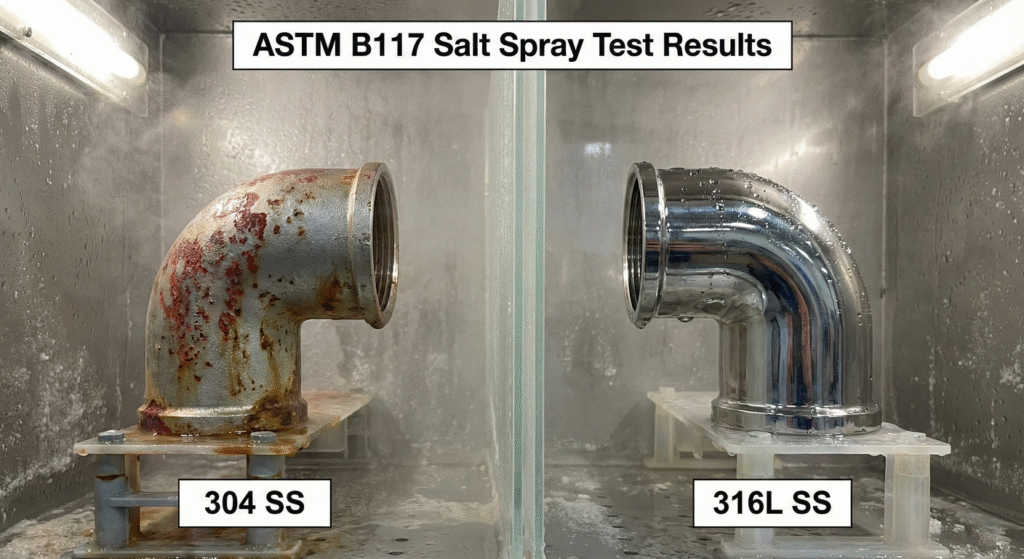
Key Point: 316L exhibits a significantly higher Pitting Resistance Equivalent Number (PREN) compared to 304 (approx. 24 vs 18). Molybdenum creates a passive film that specifically blocks chloride ions found in saltwater from penetrating the metal surface. In hydraulic adapters, this prevents the microscopic pits that lead to catastrophic high-pressure leaks.
Chemical Compatibility
Note: 316L is highly compatible with aggressive hydraulic fluids, sulfuric acid solutions, and bromides that would rapidly corrode 304. For detailed chemical resistance data, refer to authoritative sources like NACE International standards.
| Environment / Medium | 304 Performance | 316L Performance |
|---|---|---|
| Saltwater / Marine | Poor (Rusts quickly) | Excellent |
| Sulfuric Acid (<5%) | Not Recommended | Good |
| Industrial Atmosphere | Good | Excellent |
Mechanical and Performance Advantages
Strength and Fatigue Resistance
Key Point: While 304 and 316L have similar tensile strengths (approx. 515 MPa), 316L maintains its structural integrity better under cyclic loading in corrosive environments. In high-pressure hydraulic systems, corrosion fatigue is a primary failure mode; 316L mitigates this risk effectively.
Temperature and Pressure Limits
Conclusion: 316L outperforms 304 in extreme temperatures, resisting creep at high heat and maintaining toughness in cryogenic conditions. This ensures the safety and reliability of hydraulic fittings and components even when operating limits are pushed.
| Property | 304 Stainless Steel | 316L Stainless Steel |
|---|---|---|
| Tensile Strength (MPa) | ~515 | ~485 |
| Yield Strength (MPa) | ~205 | ~170 |
| Max Service Temp (Intermittent) | 870°C | 870°C |
Decision Factors for Selecting Stainless Steel
Cost vs. Performance
Key Point: 316L is generally 30-40% more expensive than 304 due to the cost of Molybdenum and Nickel. However, for hydraulic systems, the cost of a single fitting failure (downtime, cleanup, replacement) far exceeds the price difference. The total lifecycle cost of 316L is often lower.
Environmental Considerations
Note: If your equipment operates within 5 miles of the ocean or in a chemical plant, 316L is non-negotiable. For indoor, dry assembly lines, 304 is a cost-effective alternative.
Check our detailed Stainless Steel Grade Comparison or browse our 316L Hydraulic Adapters.
FAQ
Can 304 be used instead of 316L in hydraulic systems?
Yes, but only for non-corrosive, low-pressure applications. 304 is suitable for general indoor use or wash-down areas with mild detergents. It is unsuitable for chloride-rich, marine, or harsh chemical environments where it will suffer from pitting.
What are the key differences in corrosion resistance?
The primary difference is Molybdenum. 316L contains 2-3% Molybdenum, which provides vastly superior resistance to pitting and crevice corrosion caused by chlorides (salts) compared to 304, which lacks this element.
Is the extra cost of 316L justified?
Yes, for demanding applications. In high-demand, long-life, or marine hydraulic systems, the benefits of 316L—specifically reduced maintenance and failure risk—typically outweigh the initial material cost difference.