
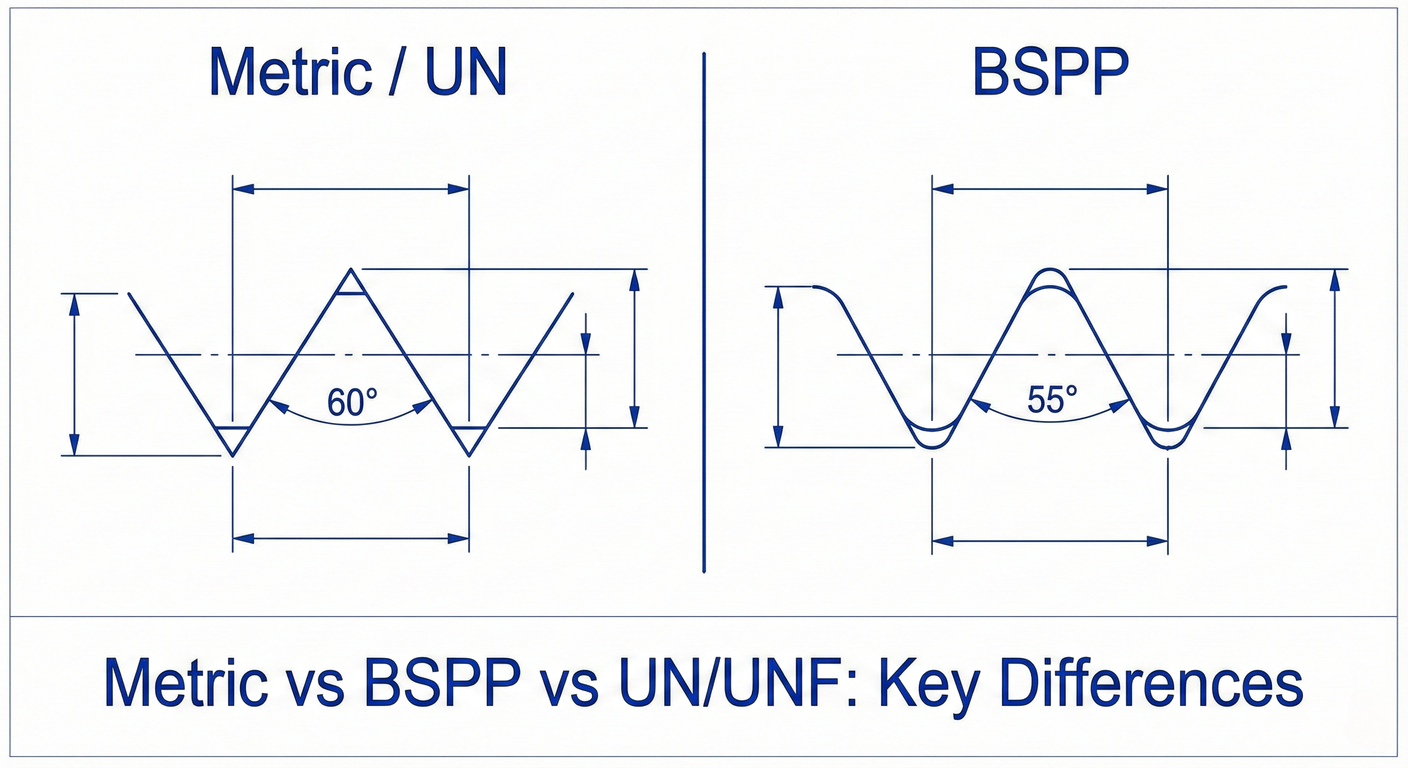
TL;DR: Thread pitch defines the specific distance between threads, but it is expressed differently across standards. Metric threads measure the distance in millimeters, whereas BSPP and UN/UNF systems count Threads Per Inch (TPI). Although some diameters appear similar, these thread systems utilize different flank angles (55° vs. 60°) and are not directly interchangeable. Identifying the correct pitch is mandatory to avoid leakage or component damage.
What Is Thread Pitch?
Definition of Thread Pitch
Point: Thread pitch is the linear distance between the crest of one thread and the crest of the next adjacent thread. In Metric systems, this is measured directly in millimeters (e.g., 1.5mm). In Imperial systems (BSPP, UN/UNF), pitch is defined as the number of threads contained within one inch of length, known as TPI.
Why Thread Pitch Matters in Engineering
Note: Incorrect thread pitch selection is the leading cause of “cross-threading” during assembly. Even if the diameter matches, a pitch mismatch (e.g., forcing a 1.0mm pitch nut onto a 1.5mm pitch bolt) will shear the thread material, compromise the holding power, and destroy the sealing capability of hydraulic adapters.
Metric Thread Pitch Explained
Metric Thread Pitch Standards (ISO)
Point: Metric threads adhere to ISO 261 standards and use a 60° thread angle. The designation format is “M[Diameter] x [Pitch]”. For example, M12 x 1.5 indicates a 12mm nominal diameter with a thread pitch of 1.5mm.
Common Metric Thread Applications
Conclusion: Metric threads are the global standard for automotive, heavy machinery (Komatsu, Kobelco), and general industrial equipment manufacturing. In hydraulics, “Metric Fine” pitch is preferred over “Metric Coarse” for better vibration resistance and sealing.
| Nominal Size | Coarse Pitch (mm) | Fine Pitch (Hydraulic Standard) |
|---|---|---|
| M10 | 1.5 | 1.0 |
| M12 | 1.75 | 1.5 |
| M14 | 2.0 | 1.5 |
| M22 | 2.5 | 1.5 |
BSPP Thread Pitch Explained
What Is BSPP Thread Pitch?
Point: BSPP (British Standard Pipe Parallel), also known as “G” thread, follows ISO 228 standards. Unlike Metric or UN, it utilizes a 55° Whitworth thread form with rounded crests and roots. Pitch is expressed solely in TPI (Threads Per Inch).
BSPP vs Metric Thread Pitch Differences
Note: A G 1/2″ fitting has a major diameter of roughly 20.9mm and 14 TPI. This is dimensionally close to M22 x 1.5, but they are absolutely incompatible due to the thread angle (55° vs 60°) and pitch difference.
| Size (Dash) | Nominal Thread | Pitch (TPI) |
|---|---|---|
| -02 | G 1/8″ | 28 |
| -04 | G 1/4″ | 19 |
| -06 | G 3/8″ | 19 |
| -08 | G 1/2″ | 14 |
UN and UNF Thread Pitch Explained
UN vs UNF Thread Pitch Definition
Point: Unified National (UN) threads use a 60° thread angle similar to metric but rely on inch-based dimensions. UNF (Unified Fine) packs more threads per inch than UNC (Unified Coarse). For example, a 1/2″ bolt is typically 13 TPI (UNC) or 20 TPI (UNF).
Typical Uses of UN/UNF Threads
Conclusion: UN/UNF threads are the standard for North American machinery, SAE J514 (JIC) fittings, and SAE J1453 (ORFS) connections. High-pressure hydraulics exclusively use UNF due to the larger tensile stress area.
| Thread Type | Diameter | Pitch (TPI) |
|---|---|---|
| JIC / UNF (-04) | 7/16″ | 20 |
| JIC / UNF (-08) | 3/4″ | 16 |
| ORFS / UNS (-08) | 13/16″ | 16 |
Metric vs BSPP vs UN/UNF: Key Differences
Pitch Measurement and Thread Form
Point: The fundamental difference lies in the thread geometry. Metric threads define the distance between peaks in millimeters. BSPP and UN/UNF count peaks per inch. Additionally, BSPP uses a 55° angle with rounded roots, while Metric and UN/UNF use a 60° angle with flat or rounded roots.
Interchangeability and Compatibility Risks
Note: Threads with similar diameters may initially engage by hand (e.g., G 1/2″ and 1/2″-14 NPT), but they are not interchangeable. Forcing them together will cause thread galling and inevitable leakage under pressure.
| Standard | Angle | Pitch Unit | Typical Designation |
|---|---|---|---|
| Metric | 60° | Millimeters (mm) | M14 x 1.5 |
| BSPP | 55° | TPI | G 1/4″ |
| UN/UNF | 60° | TPI | 7/16-20 UNF |
How to Identify and Choose the Correct Thread Pitch
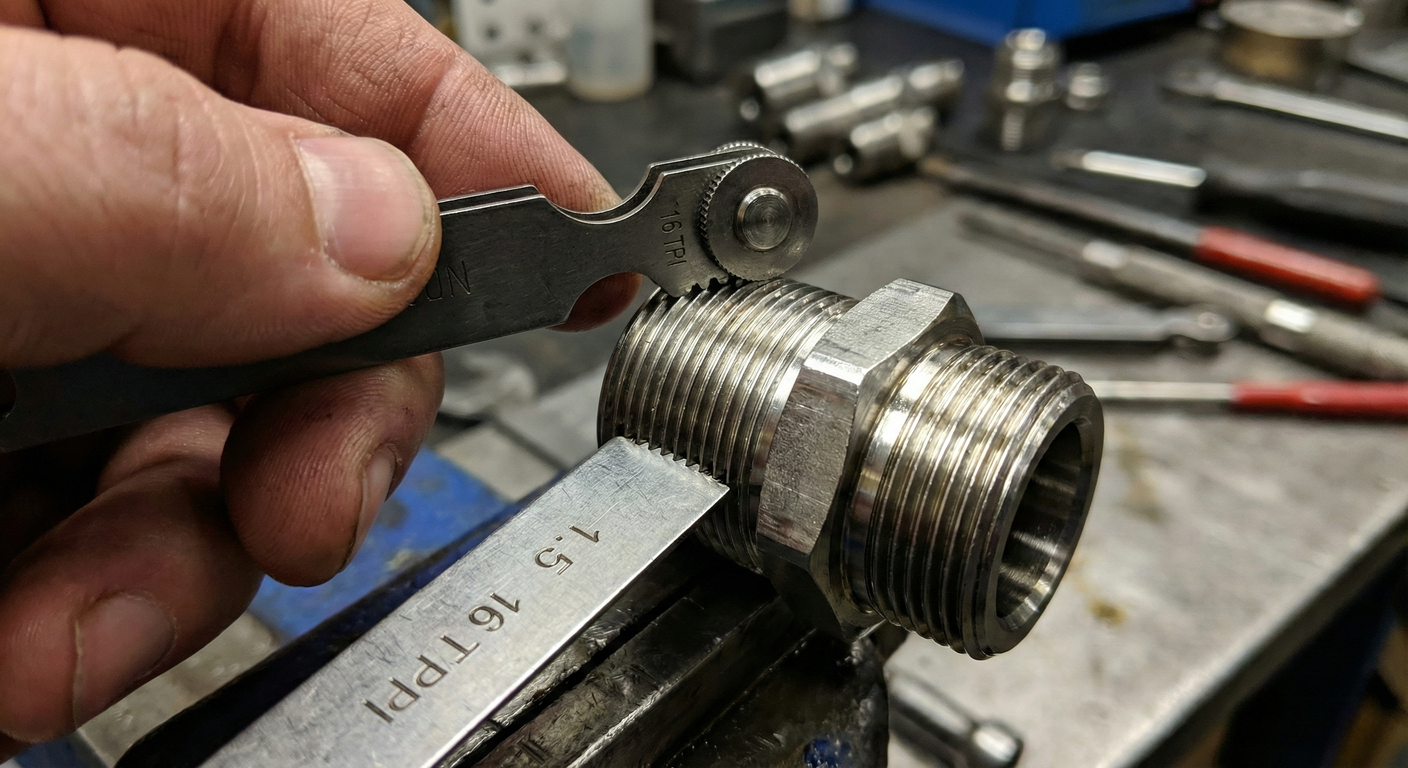
Measuring Thread Pitch Correctly
Point: Never guess based on visual appearance. Use a thread pitch gauge to confirm the exact spacing or TPI. Combine this with digital calipers to measure the major diameter (OD) of the male thread. If a metric gauge leaf fits but has gaps, try the imperial leaves.
Selection Tips for Engineers and Buyers
Conclusion: Always verify the thread standard specified on the equipment drawings or OEM documentation before ordering. For replacing fittings on unidentified machinery, use a thread identification kit to determine if the port is Metric, BSPP, or UNF.
Learn more in our Guide to Thread Identification or review the Hydraulic Thread Standards Overview.
FAQ
Can metric and BSPP threads be mixed?
No. Despite having similar diameters in some sizes, they differ in both thread pitch (mm vs. TPI) and flank angle (60° vs. 55°), preventing a proper seal.
Is UNF the same as metric fine thread?
No. UNF uses TPI (Threads Per Inch) measurements and specific inch-based diameters, whereas metric fine threads use millimeter pitch and metric diameters.
What tools are best for identifying thread pitch?
Thread pitch gauges and calipers are the most reliable tools. A pitch gauge set should include leaves for both Metric (mm) and Imperial (TPI) profiles.