
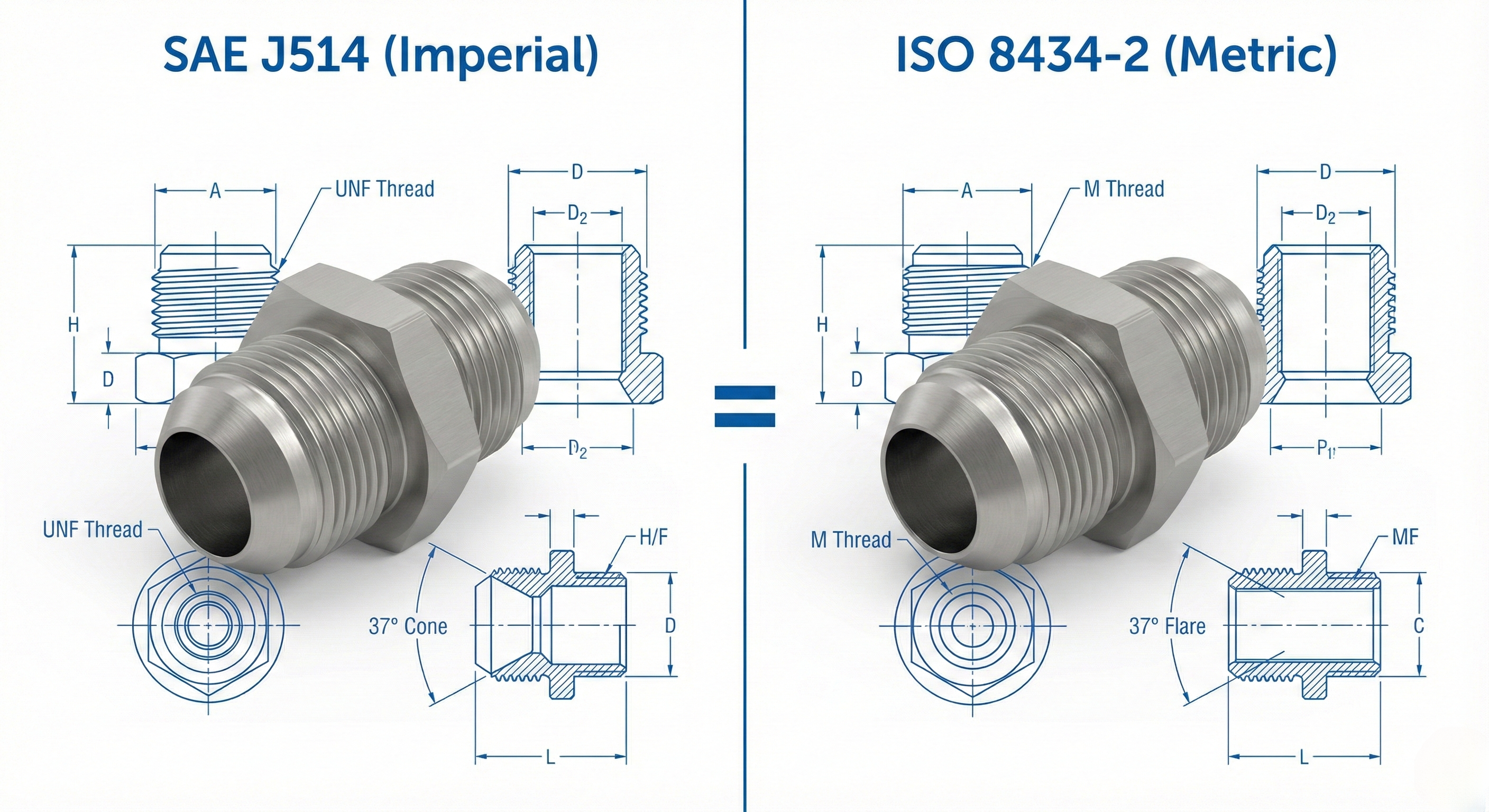
TL;DR: SAE J514 and ISO 8434-2 define the same JIC 37° flare fitting system. They are dimensionally and functionally interchangeable. The only difference lies in the documentation format and unit expression (imperial inch vs. metric mm). For global procurement, specifying either standard ensures you receive the exact same compatible component.
Are SAE J514 and ISO 8434-2 the Same Standard?
Short Answer: Yes.
Both standards specify exactly the same technical requirements for hydraulic connections. They share the same 37° flare sealing geometry (metal-to-metal) and the same UN/UNF thread forms (Unified Fine). Furthermore, they adhere to the same pressure performance expectations relative to fitting size.
From an engineering and application standpoint, SAE J514 and ISO 8434-2 fittings can be used interchangeably without modification.
Key Takeaway: SAE J514 and ISO 8434-2 are fully interchangeable JIC 37° flare standards.
Related Context: SAE J514 vs ISO 8434-2, JIC 37° flare standard interchangeable
Why Do Two Different Standards Exist for the Same JIC 37° Flare?
This difference is administrative, not technical. The dual standards exist to bridge regional documentation habits and measurement systems.
- SAE J514: Originated in North America by the Society of Automotive Engineers (SAE). It uses imperial units (inches) for hex sizes and lengths.
- ISO 8434-2: Developed by the International Organization for Standardization (ISO) to harmonize the standard for global use. It expresses the same dimensions using metric notation (millimeters) but retains the original UN/UNF threads.
Conclusion: ISO 8434-2 did not redesign JIC fittings—it merely repackaged SAE J514 for international standardization.
For a broader overview of fitting types, refer to our guide on Identifying Hydraulic Fittings.
Dimensional and Thread Comparison: SAE J514 vs ISO 8434-2
Confusion often arises when comparing data sheets side-by-side. Both standards specify a 37° flare seat angle and UN/UNF straight threads. The sealing interface geometry is identical.
What Is Actually Different?
The differences are purely in how the technical data is presented:
- Dimension Tables: ISO converts inch decimals to millimeters.
- Hex Sizes: ISO may list metric equivalent hex sizes (e.g., 19mm instead of 3/4″), which are functionally compatible within tolerances.
- Standard Reference: Different organizations manage the updates and revisions.
| Feature | SAE J514 (USA) | ISO 8434-2 (International) |
|---|---|---|
| Thread Type | UN/UNF Class 2A/2B | UN/UNF Class 2A/2B |
| Seat Angle | 37° Flare | 37° Flare |
| Pressure Rating | Identical | Identical |
| Units Used | Imperial (Inches) | Metric (Millimeters) |
Related Context: SAE J514 ISO 8434-2 dimensions, JIC 37° fitting dimensions
Pressure Ratings and Material Compatibility
Pressure performance is determined by the fitting size, material, and manufacturing quality. For example, a -04 (1/4″) fitting typically handles higher pressure (6000 PSI) than a -32 (2″) fitting (2000 PSI).
At Kaitu, we manufacture these adapters in carbon steel, SS304, and SS316L. The standard itself does not change pressure capability; the material quality does.
| Dash Size | Tube OD (inch) | Max Working Pressure (SS316L) |
|---|---|---|
| -04 | 1/4″ | 6000 PSI |
| -06 | 3/8″ | 5000 PSI |
| -08 | 1/2″ | 5000 PSI |
| -12 | 3/4″ | 4500 PSI |
| -16 | 1″ | 4000 PSI |
For more details on material limits, see our guide on Pressure Ratings for Stainless Steel Hydraulic Adapters.
Can SAE J514 and ISO 8434-2 Fittings Be Mixed in One System?
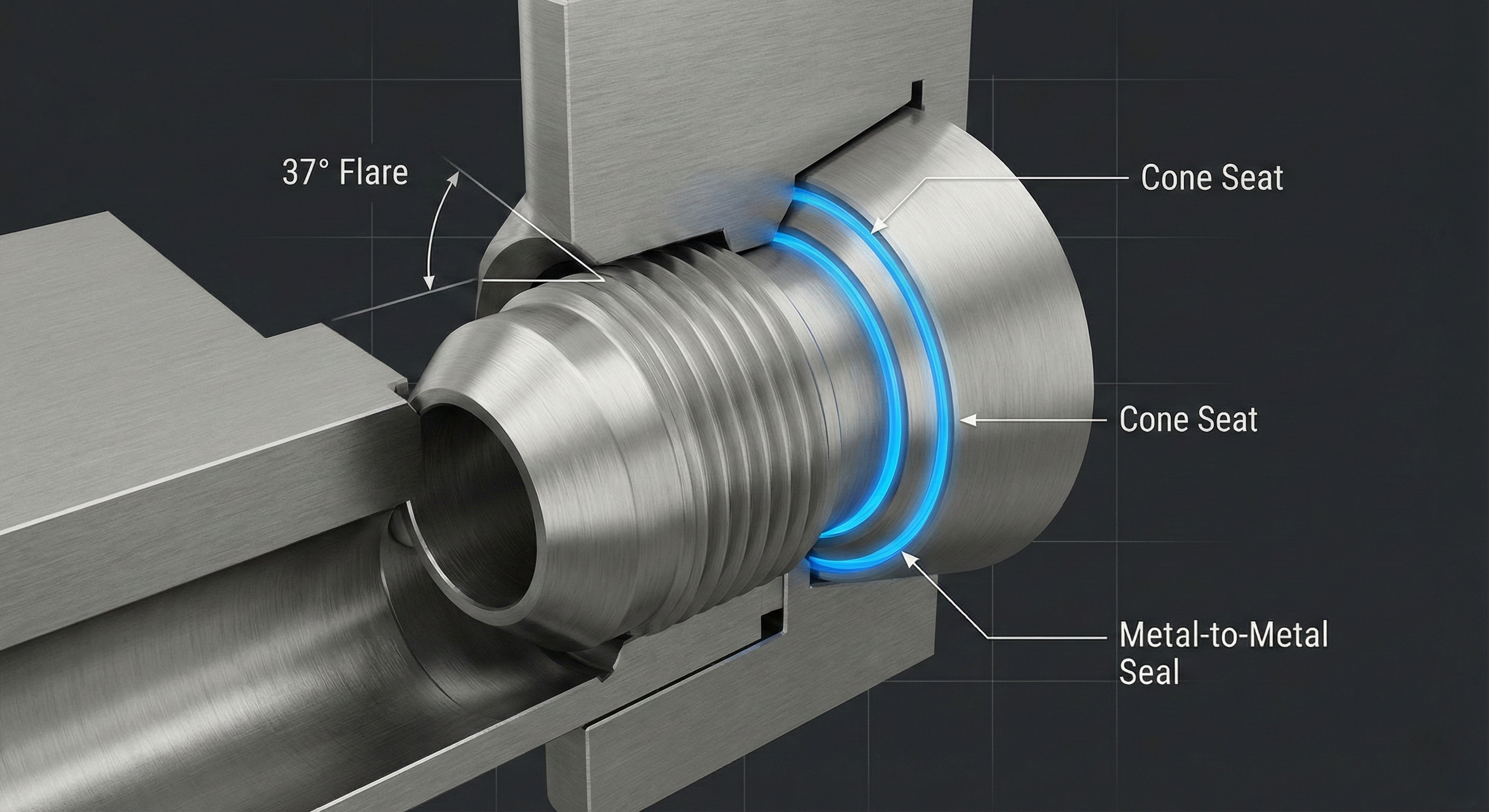
Yes — mixing is acceptable and common in practice. You can safely mate an SAE J514 hose end with an ISO 8434-2 adapter block without leaking.
Checklist for Safe Mixing:
- Ensure both fittings are the same dash size (e.g., both are -08).
- Verify both are the same material grade to prevent galvanic corrosion.
- Apply the proper torque specified for 37° flares.
⚠️ What CANNOT be mixed:
- Do not mix JIC 37° with SAE 45° (refrigeration fittings). They will leak.
- Do not mix JIC with BSPP 60° cone seats. The threads are different.
When Should You Reference SAE J514 vs ISO 8434-2?
Since the physical part is identical, choose the standard reference based on your customer documentation requirements and regional compliance needs.
- Engineering Reality: The fitting itself does not change. A CNC machine produces the same geometry for both.
- Buying Reality: ISO 8434-2 is often preferred for international procurement outside of North America to simplify metric BOMs.
If you need to source these adapters, check our Buying Guides for Hydraulic Adapters to select the right inventory.
FAQ
Are SAE J514 and ISO 8434-2 interchangeable?
Yes. They define the exact same JIC 37° flare fitting system. Dimensions, threads, and sealing angles are identical, making them fully interchangeable in any hydraulic application.
Does ISO 8434-2 use metric threads?
No. Even though ISO 8434-2 is a “metric” standard, it still specifies UN/UNF (Unified Fine) threads for the connection. It simply expresses the thread dimensions using millimeters in the data tables.
Is JIC 37° the same as SAE 45°?
No. While they look similar, the flare angles are different (37 degrees vs. 45 degrees). Mating them will result in a line contact rather than a full face seal, causing immediate leakage.
Can ISO 8434-2 fittings replace SAE J514 in existing systems?
Yes. As long as the size (e.g., -08) and material (e.g., Stainless Steel) match, an ISO 8434-2 fitting is a direct drop-in replacement for an SAE J514 fitting.
Summary for Engineers and Buyers
Do not let the different standard numbers confuse your procurement process.
- SAE J514 = The original North American standard for JIC 37°.
- ISO 8434-2 = The international equivalent for the same part.
- There is no dimensional or functional difference.
- Selection depends entirely on your documentation preference, not performance capabilities.
Related Context: JIC 37° flare fitting standard comparison, SAE vs ISO hydraulic fittings
Need help identifying your fittings? Contact Kaitu Technical Support today.