
Hydraulic fittings use a few main O-ring types to stop leaks and work well. You will often see Flare-O, O-Ring Boss, O-Ring Face Seal, split flanges, and bonded seals in these systems. The table below explains how each type works and what materials are used:
| O-ring Type | Application/Usage Description | Material Options |
|---|---|---|
| ORFS fittings | Makes a strong connection for high-pressure hydraulic systems. Stops leaks. | Different elastomers |
| O-ring boss fittings | Makes leak-proof connections. Used a lot in airplanes. | 90 durometer Buna-N |
| O-ring face seal | Makes tight seals in hydraulic systems. | Different elastomers |
| Flare O-rings | Stops leaks if put in the right way. | Buna-N or Viton |
| Split flanges | Seals joints that have pressurized fluid inside. | Elastomeric O-rings |
| Bonded seal O-rings | Used as bolt seals in hydraulic machines. | Metal and rubber elastomer |
Picking the right o rings for hydraulic fittings keeps your system safe from leaks. Studies show that using the correct O-ring type and material for your system helps the seal work better and lowers the chance of failure.
O-Ring Seal Types
Hydraulic systems rely on different O-ring seal designs to keep fluid inside and prevent leaks. You need to know how each type works and where you can use it. Here are the main O-ring seal types you will find in hydraulic fittings:
Flare-O O-Rings
Flare-O O-rings fit between the flare of a tube and the fitting. You use them to seal connections in hydraulic lines. The O-ring sits in a groove and gets compressed when you tighten the fitting. This compression creates a tight seal that stops leaks. Flare-O O-rings work well in systems with moderate pressure. You often see them in agricultural and construction equipment. Standard sizing for Flare-O O-rings follows the inner diameter and cross-sectional diameter. You must check the groove size to make sure the O-ring fits snugly.
O-Ring Boss (ORB) Seals
O-Ring Boss seals use a straight-thread fitting with an O-ring placed in a chamfered groove. When you tighten the fitting, the O-ring gets squeezed between the male and female parts. This action creates a leak-proof seal. You find ORB seals in high-pressure hydraulic systems, such as those in aircraft and industrial machinery. These seals use standard O-ring sizes, so you can easily match them to your fitting. Always verify the material and size to ensure compatibility with your hydraulic fluid and temperature range.
O-Ring Face Seals
O-Ring Face Seals, also called ORFS, use an O-ring placed in a groove on the face of the fitting. When you connect two fittings, the O-ring gets compressed between the flat faces. This design gives you a strong seal, even at very high pressures. You see ORFS seals in heavy-duty hydraulic equipment and mobile machinery. The sizing for these O-rings follows industry standards, including inner diameter and cross-sectional thickness. You need to check tolerances to make sure the seal works under pressure.
Tip: Always match the O-ring size and material to your system’s needs. This helps you avoid leaks and keeps your hydraulic system running smoothly.
You will also find other designs, such as standard O-rings, backup rings, and quad rings. Standard O-rings work in both static and dynamic applications. Backup rings prevent extrusion in high-pressure systems. Quad rings have a four-lobed shape that reduces friction and wear.
When you select o rings for hydraulic fittings, pay attention to sizing conventions. The inner diameter and cross-sectional diameter matter most. Tolerances allow for small differences in size, so your seal stays effective. Compatibility with hydraulic fluids and temperature is also important. You want to make sure your O-ring can handle the environment inside your system.
O Rings for Hydraulic Fittings: Materials
Picking the right material for o rings helps stop leaks. It also keeps your hydraulic system working well. Each material has good and bad points. You need to match the material to your fluid, temperature, and where you use it.
Buna-N (Nitrile)
Buna-N is also called Nitrile. It is the most used material for o rings in hydraulic fittings. You find it in engines, oil systems, gearboxes, aircraft pumps, water systems, and machines. Buna-N works best with fluids made from petroleum and mineral oils.
Here is a table that shows Buna-N O-ring properties:
| Property | Details |
|---|---|
| Temperature Range | –31°F (–35°C) to 230°F (110°C) |
| Specialty Low Temperature | –76°F (–60°C) |
| Specialty High Temperature | 275°F (135°C) |
| Compatible Hydraulic Fluids | HFA, HFB, HFC types |
| Chemical Compatibility | Petroleum oils, mineral oils, vegetable oils, silicone greases/oils |
| Limitations | Not resistant to ketones, halogenated hydrocarbons, strong acids, etc. |
Note: Buna-N O-rings do not stand up to ozone or flames. Do not use them with brake fluids, acetones, or outside where there is lots of ozone.
Viton (Fluorocarbon/FKM)
Viton O-rings resist fuels, oils, solvents, and acids very well. You can use them in hydraulic systems with high heat. Viton keeps its shape and seal even with strong chemicals.
- Temperature Range: –15°F to 400°F (some types up to 437°F)
- Chemical Resistance: Great for fuels, oils, solvents, and acids
- Pressure Stability: Holds pressure and stops leaks
- Durability: Lasts long and does not wear out fast
| Chemical Type | Resistance Level |
|---|---|
| Fuels, oils, solvents, acids | Excellent |
| Ketones, amines, ammonia | Limited |
Tip: Viton O-rings work best with petroleum fluids and high heat. Do not use them with Skydrol, ketones, or amines.
EPDM
EPDM O-rings stand up to alkalis, mild acids, and oxygen-based solvents. You can use them with water fluids, steam, and brake fluids. EPDM works well outside because it resists UV and ozone.
| Property | Value |
|---|---|
| Temperature Range | –58°F to 302°F |
| Heat Resistance | Up to 302°F |
| Cold Flexibility | Down to –70°F |
- Best For: Water fluids, steam, brake fluid (DOT 3, DOT 4), outdoor use
- Not Good For: Petroleum hydraulic oils
Alert: EPDM O-rings will break if used with mineral oil fluids. Always check your fluid before picking EPDM.
FFKM
FFKM O-rings give the best chemical resistance and handle high heat. You can use them in tough places with strong acids, solvents, and very hot temperatures. FFKM keeps its seal even when stressed or heated.
| Property | Description |
|---|---|
| Chemical Resistance | Stands up to almost all chemicals, solvents, and acids |
| Temperature Range | –15°F to 600°F (some grades up to 700°F) |
| Mechanical Properties | Seals well under stress and temperature changes |
- Great chemical resistance to over 1,800 chemicals
- Wide temperature range from –55°C to 330°C
- Stays flexible and bounces back like rubber
FFKM O-rings are best for aerospace, semiconductor, energy, medicine, and factories. Pick FFKM for hydraulic fittings in very tough conditions.
Silicone
Silicone O-rings have strong heat stability and bend easily. You can use them in medical tools and food machines because they are safe. Silicone works in many temperatures.
| Property | Range |
|---|---|
| Temperature (Standard) | –65°F to 400°F |
| Temperature (Specialty) | –100°F to 500°F |
| Fluid Compatibility | Ketones, acids, silicone oils, brake fluids |
- Silicone O-rings stand up to many chemicals but not high heat steam.
- You can use them where things move and need to bend.
Note: Silicone O-rings are not as strong as other types in high-pressure or steam hydraulic systems. Use them when heat stability and chemical resistance matter more than pressure.
Performance and Compatibility
Fluid Compatibility
You need to pick the right O-ring material for your fluid. If you choose the wrong one, the O-ring can swell or get hard. It might even break apart. This can cause leaks and make the seal wear out faster. Here are some things to remember about fluid compatibility:
- The right fluid keeps O-rings soft and working well.
- Wrong fluids can make O-rings swell or get stiff.
- Using the wrong fluid for a long time wears out seals.
Check the table below to see which O-ring materials work best with different fluids:
| Hydraulic Fluid Type | Recommended O-Ring Material |
|---|---|
| Mineral Oil-Based | NBR, HNBR, FKM |
| Phosphate Ester (Skydrol) | EPDM, PTFE |
| Water-Glycol | EPDM |
| Synthetic Esters (HEES/HEPG) | FKM, HNBR |
| Bio-Oils (vegetable-based) | HNBR, FKM |
Tip: Always check your fluid before picking o rings. This helps stop chemical damage and keeps your system working longer.
Temperature and Pressure
O-rings need to handle the heat and pressure in your system. If it gets too hot, the seal can crack or get hard. If it gets too cold, the seal can break easily. Pressure changes can push the O-ring into spaces, causing leaks.
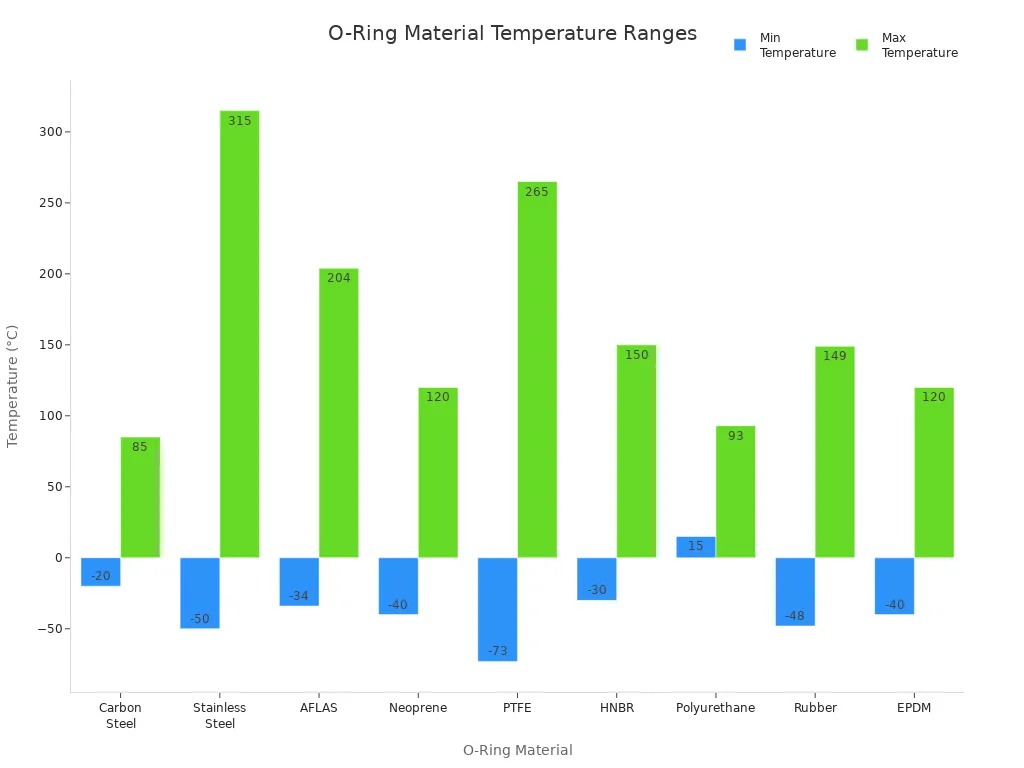
Here is a table that shows how much heat and pressure O-ring materials can take:
| O-Ring Material | Temperature Range (°C) | Pressure Limit (MPa) |
|---|---|---|
| Carbon Steel | -20 to +85 | 40 |
| Stainless Steel | -50 to +315 | 100 |
| AFLAS | -34 to +204 | N/A |
| Neoprene | -40 to +120 | N/A |
| PTFE | -73 to +265 | N/A |
| HNBR | -30 to +150 | N/A |
| Polyurethane | 15 to +93 | N/A |
| Rubber | -48 to +149 | N/A |
| EPDM | -40 to +120 | N/A |
- Pressure changes can squeeze O-rings into spaces and cause leaks.
- High heat makes seals hard and easy to crack.
- Cold makes seals stiff and easier to break.
Durability
You want your O-rings to last a long time. If you tighten the fitting too much, the O-ring can get flat and stop working. Compression set happens when the O-ring loses its shape and cannot seal. High heat, bad material, or poor design can cause this. Sometimes, you see cracks or pits from heat or air.
To help your O-rings last longer:
- Clean surfaces before you put in the O-ring.
- Use a little bit of safe lubricant.
- Line up seals the right way.
- Follow the maker’s rules for tightening and squeezing.
- Use safe lubricants when you install O-rings.
- Check seals often for damage or chemical problems.
- Keep extra O-rings and lubricants in a cool, dry spot.
Note: Keeping fluid levels right helps stop friction and heat. Do not overfill, because too much pressure can hurt seals.
Choosing the Right O-Ring
System Requirements
When you choose an O-ring for a hydraulic fitting, you need to look at several key system requirements. Each factor helps you make sure the O-ring will seal well and last a long time.
- Inner Diameter (I.D.): You must measure the groove and pick an O-ring with the right inner diameter. This keeps the O-ring snug and stops leaks.
- Cross-Sectional Diameter (C.S.): The thickness of the O-ring affects how much it gets squeezed. The right thickness gives you a better seal.
- Groove Dimensions: Always check the groove size. The groove must match the O-ring’s I.D. and C.S. for a good fit.
- Size Chart Consultation: Use AS568 size charts to find the correct dash number for your O-ring.
- Tolerances: Small differences in size can affect sealing. Make sure the O-ring fits even if there are small changes in the groove or ring.
- Material Selection: Pick a material that matches your system’s temperature and fluid type.
- Compatibility Verification: Make sure the O-ring can handle the chemicals, heat, and pressure in your system.
You also need to think about how your system runs. The table below shows how different factors affect your O-ring choice:
| Factor | Description |
|---|---|
| Temperature Extremes | High heat can melt O-rings. Cold can make them brittle. Silicone or Viton® work for high heat. Nitrile and EPDM work for cold. |
| Pressure Requirements | High pressure needs strong O-rings to stop them from squeezing out. Lower pressure can use softer O-rings. |
| Fluid Compatibility | The O-ring must resist the fluid in your system. The right material will last longer and seal better. |
Selection Checklist
You can use this checklist to help you pick the right O-ring for your hydraulic fitting:
- Measure the groove and check the inner diameter and cross-section.
- Look up the correct size using an AS568 chart.
- Choose a material that matches your fluid and temperature needs.
- Check the pressure rating for your system.
- Make sure the O-ring fits with the groove tolerances.
- Confirm the O-ring resists the chemicals in your system.
Tip: If you are not sure, talk to a supplier or check technical guides. They can help you find the best O-ring for your job. Always double-check your choice before you install the O-ring. This helps you avoid leaks and keeps your system safe.
Choosing the right O-ring helps your hydraulic system stay safe. It also keeps leaks from happening. You must match the O-ring type and material to your fluid. You also need to think about temperature and pressure. If you pick the wrong material, it can wear out fast. It might lose its seal and stop working. Changes in temperature can hurt O-rings. Chemicals can also damage them.
| Key Factor | Why It Matters |
|---|---|
| Material Selection | Stops fast wear and chemical harm |
| Temperature Resistance | Keeps O-ring soft and sealing well |
| Operating Pressure | Helps seal work under stress |
You should install O-rings the right way. Check them often and replace them before they fail. Using a checklist or asking an expert can help you avoid leaks. This also saves money by stopping big problems.
FAQ
What is the most common O-ring material for hydraulic fittings?
Buna-N (Nitrile) is the most common. You will find it in many hydraulic systems. It works well with petroleum-based fluids and handles normal temperatures.
How do you know if an O-ring fits your hydraulic fitting?
You should measure the groove and check the O-ring’s inner diameter and cross-section. Use an AS568 size chart to match the right size. Always test the fit before final installation.
Can you reuse O-rings in hydraulic fittings?
You should not reuse O-rings. Old O-rings can get flat, crack, or lose flexibility. Always use a new O-ring to make sure your seal works and to prevent leaks.
Which O-ring material should you use for high temperatures?
Viton (FKM) and Silicone O-rings work best for high heat. Viton handles up to 400°F. Silicone can go even higher. Check your system’s temperature before you choose.
What causes O-ring failure in hydraulic systems?
- Wrong material choice
- Too much heat or pressure
- Chemical attack
- Poor installation
You can prevent most failures by picking the right O-ring and installing it carefully.